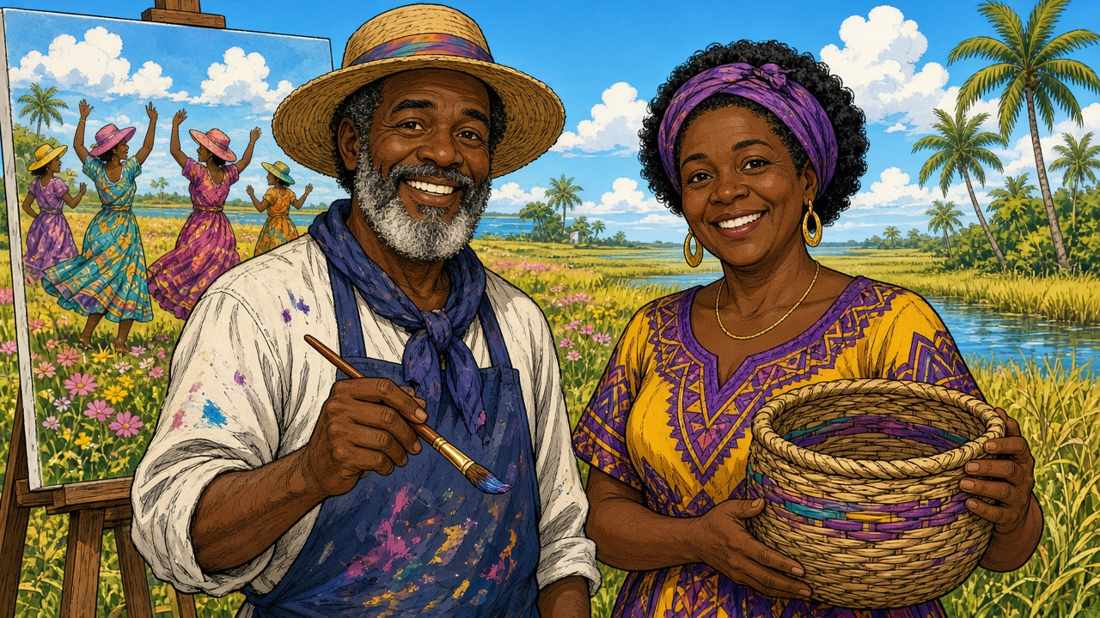
Bright skirts, wide-brimmed hats, a woman dancing with her arms flung open: the paintings of Jonathan Green look joyful at first glance. Look longer, and they open into history. The Cameron Art Museum in Wilmington, North Carolina, has devoted a major exhibition to the artist, Rooted in Memory: The Gullah Geechee Vision of Jonathan Green, on view until 24 January.
An artist of the Lowcountry
Green was born in Gardens Corner, South Carolina, and trained at the School of the Art Institute of Chicago. His work is shaped by his Gullah Geechee heritage — the culture of descendants of enslaved West and Central Africans along the coast and Sea Islands of the American Southeast, with its own language, crafts and traditions.
Curator Ben Billingsley‘s favourite piece is Time to Rejoice (2005): nine women in vivid clothing gather in a clearing around a tenth who dances in ecstasy. The scene echoes Baby Suggs’s sermon in the clearing from Toni Morrison’s Beloved, yet the clothes are contemporary — a deliberate link between past and present.
Faces turned away
Many of Green’s women have their faces partly hidden by hat brims, lowered gazes or turned backs. Billingsley calls this a productive tension: it invites curiosity about what the figures are thinking, and it lets them become universal stand-ins in which visitors recognise people from their own lives. He also describes the work as “deceptively simple” — up close, there are hundreds of brushstrokes per square inch.
A collection, a culture, a what-if
The show grew out of an anonymous family of museum members who have collected Green for three generations and lent part of their holdings, letting the museum show how collections are built over time. Loans from the South Carolina State Museum, the Gibbes Museum and the Charleston Museum add sweetgrass baskets, quilts and Gullah dolls, setting the paintings within a living material culture.
A surprising highlight is a group of four watercolours: costume designs Green made for a Porgy and Bess production at the Sapelo festival. They imagine what American fashion might look like if West African textile, printing and weaving traditions had arrived through free migration rather than forced labour — a gentle, radical thought experiment, and a fitting summary of an artist who paints memory as something alive.