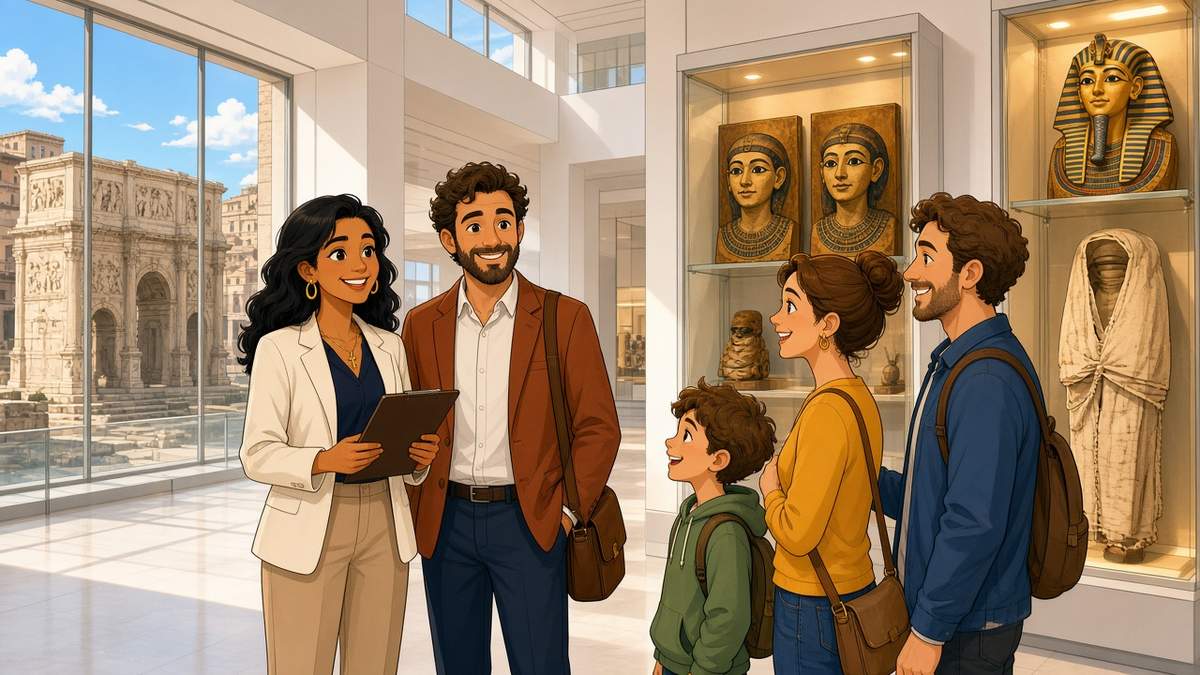
They are among the earliest painted portraits that still look straight back at us. Starting Wednesday, 4 November 2026, the Ara Pacis museum in Rome presents “Egypt and Rome, the Faces of Fayum”, an exhibition that organisers describe as a milestone of cultural cooperation between Italy and Egypt. It runs until 2 May 2027.
Faces painted for the afterlife
The so-called Fayum portraits were made between the first and third centuries AD, after Egypt had become a province of the Roman Empire. Painted on thin wooden panels, often only a few millimetres thick, they were placed over the face of the deceased and wrapped into the mummy bandages. The result is a striking blend of two worlds: the sitters often have Egyptian features but wear Roman clothing, and the painting style grows out of the Hellenistic tradition.
What makes these panels so arresting is their realism. Some show grey hair and wrinkles, others the long lashes and round cheeks of a child. The dry climate of the Fayum, a fertile area on the edge of the desert, is the reason the fragile wood, textiles and papyri have survived at all.
Loans that rarely travel
Most of the objects come from Egypt, and some are leaving the country for the first time. The star of the show is the “Tondo of the Two Brothers” from the Egyptian Museum in Cairo, a recently restored double portrait from the age of Emperor Hadrian that shows two curly-haired young men with large, soulful eyes. Claudio Parisi Presicce, Rome’s top official for cultural heritage, called it an “absolute masterpiece” and perhaps the most important painting to survive from antiquity.
Besides the portraits, visitors will find mummies, masks, shrouds, jewellery, marble busts and statues. Further loans come from the Louvre, the Metropolitan Museum of Art, the J. Paul Getty Museum and the Landesmuseum Württemberg, among others. A highlight from Paris is an almost pristine linen shroud showing a man standing between the mummy he will become and Anubis, the jackal-headed god who guided the dead into the afterlife.
Why it matters
The show arrives at a moment when museums everywhere are rethinking how they present ancient human remains and objects from Egypt. By building the exhibition around a partnership with Egyptian institutions, Rome offers a model that puts collaboration rather than possession at the centre. For visitors, it is a rare chance to look into faces that were painted to be remembered and still are, almost two thousand years later.