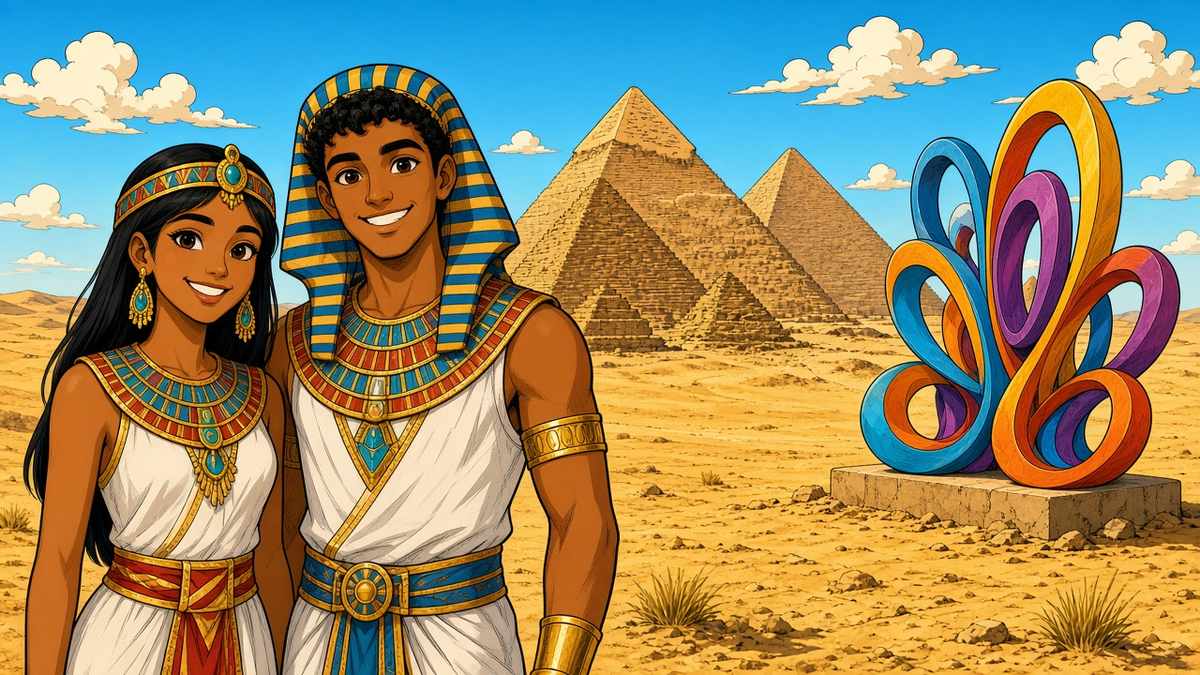
For the sixth time, the desert beside the pyramids has become an open-air gallery. “Forever Is Now”, the international contemporary art exhibition organised by the Egyptian arts company Art D’Egypte, opened on Sunday, 8 November 2026, on the Giza Plateau and runs until 28 November. Its theme, as in previous editions, is time itself: what it means to make new work in front of monuments that have stood for four and a half thousand years.
Guardians, gates and a single eye
The most talked-about work this year is It Is Time to Plant Love by the French-Chinese artist Jiang Qiong Er: twelve towering gold-coloured guardian figures in stainless steel and fibreglass, inspired by ancient civilisations around the world and meant to stand for shared values such as peace, freedom, equality and wisdom. “At a time when most artists are striving to find differences, I am truly seeking common ground,” she told the Xinhua news agency. Her presence has extra weight because Egypt and China mark 70 years of diplomatic relations in 2026; according to Art D’Egypte founder Nadine Abdel Ghaffar, it is also the exhibition’s first collaboration with a Chinese artist.
The British-French artist Charlotte Colbert has installed Possible Landscapes, a monumental silver steel arch crowned with a single eye that refers to the Eye of Horus, the ancient Egyptian symbol of protection and healing. Colbert described the pyramids as “the ultimate door between our world and the other world”. Gates and passages recur throughout: the Turkish sculptor Seçkin Pirim calls his limestone colonnade The King’s Road “a gate and a portal” from the present towards the pyramids, while the French-American artist Raphaele Shirley has built Passage, a walk-through tunnel of concentric arches made of woven palm reed, copper and steel that throws moving shadows onto the sand.
Stone, myth and a board game
Several works speak directly to Egyptian tradition. Emad Abu Grain’s Talisman of Salvation uses six carved stone blocks and rope to evoke the Book of the Dead and the ancient belief that knowledge was the key to eternity. The British-Jamaican artist Rochelle Nembhard presents Celestial Vessels, eight egg-shaped limestone forms drawn from Egyptian creation myths. The Saudi artist Abdul Rahman Taha stacks pieces of tawla, the board game played in cafés across Egypt, into stone sculptures titled The Gathering. And the French painter Geoffroy Pithon’s Hortus Pictus is a brightly painted structure whose openings frame the pyramids and the Giza landscape like a series of pictures.
Art for everyone
Abdel Ghaffar stresses that the exhibition is open to all and draws school and university groups every year; art, she says, should not be limited to collectors. She also sees it as a showcase for the country today: international visitors and media come to see not only a 7,000-year-old civilisation “but also contemporary Egyptians”. Since its first edition, “Forever Is Now” has helped make the plateau a fixture on the autumn art calendar — a three-week exhibition in which the oldest stage in the art world is shared, for a while, with the newest work.