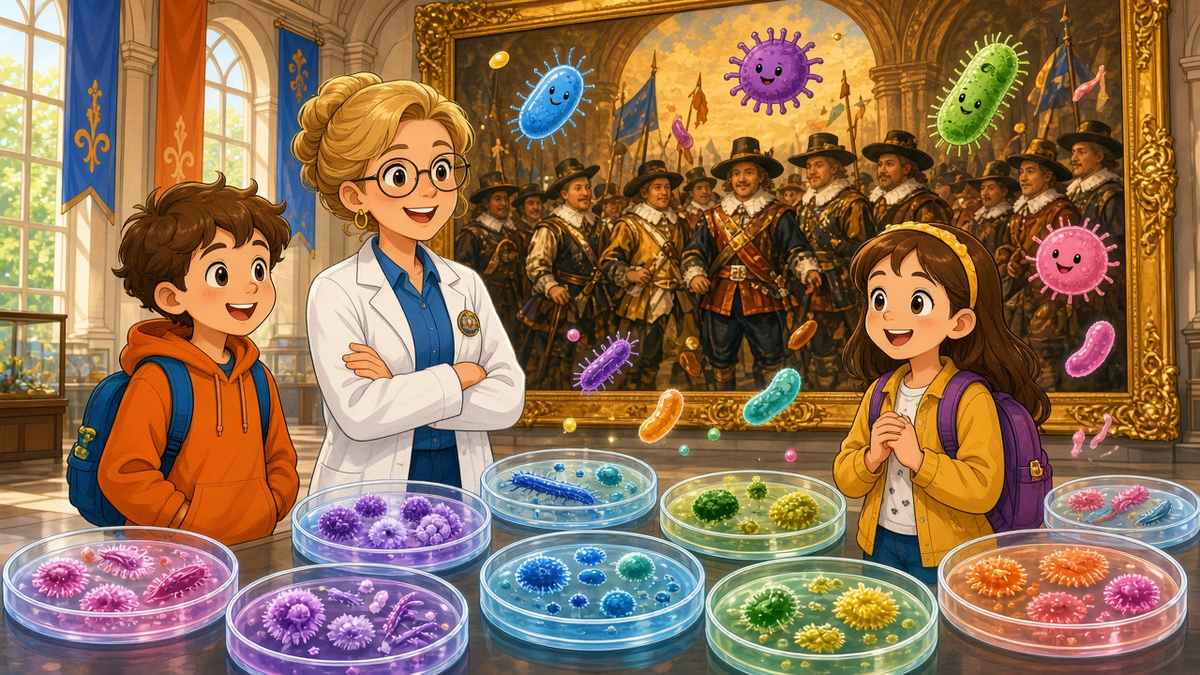
For almost four centuries, viewers of Rembrandt’s Night Watch have looked at the captain, the lieutenant, the drummer and the mysterious girl in gold. What nobody could see was a second crowd living on the canvas. From 11 November 2026, a new installation in Amsterdam makes that invisible population visible: “The Night Watch Lives”, a joint project of the Rijksmuseum and Artis-Micropia, the city’s museum of microbes.
Sixty sampling spots, six months of work
According to the organisers, samples were taken over a period of six months from around sixty different spots on the painting. The bacteria were isolated, grown into colonies and are now displayed in Petri dishes at Artis-Micropia – next to a life-size reproduction of the Night Watch, so visitors can connect each colony to the area of the picture it came from.
Most of what the team found is ordinary. Microbiologist Eline van Bloois of Artis-Micropia told AFP that many of the microbes are the kind commonly found on human skin or in soil. They are not harmful to the painting, she stressed. And no, nobody can say whether any of them go back to Rembrandt himself: from a single microbe, van Bloois explained, it is impossible to tell whether it has been there for 400 years or for one day.
A puzzle from Japan
The biggest surprise came from an area where old varnish had been removed. There the researchers identified Microbacterium saccharophilum, a bacterium usually associated with a sugar refinery in Japan. How it arrived on a Dutch canvas from 1642 is an open question – one that, in van Bloois’s words, will keep her up for years. “That’s the beauty of science,” she said: you ask one question and get a hundred in return.
Part of Operation Night Watch
The installation belongs to Operation Night Watch, the large research and restoration project the Rijksmuseum has been running since 2019. The painting is being studied and treated inside a specially built glass chamber in the museum, where visitors can watch conservators and scientists at work. Few paintings in the world have been scanned, photographed and analysed as thoroughly – and the microbe survey adds a biological layer to the chemical and technical data.
The aim of the show is less forensic than poetic: to spark curiosity about the life that surrounds us everywhere, even on the most protected masterpiece in the Netherlands. Van Bloois describes the project as proof of how closely art and science are connected – and suggests that the dishes full of coloured colonies are “little works of art in their own right”.
Why it matters
Museums increasingly treat their icons not just as images but as objects with a physical history: pigments that change, varnishes that age, surfaces that collect traces of every century they pass through. Showing this openly, rather than hiding it behind the restoration studio door, is part of a wider trend in conservation communication. “The Night Watch Lives” turns that idea into something families can literally look at under the lens.
Visit: “The Night Watch Lives”, Artis-Micropia, Amsterdam, open to the public from 11 November 2026. The original painting remains on view at the Rijksmuseum.