The 29th edition of Paris Photo closes today, 15 November, at the Grand Palais – and one of its most discussed areas sits right at the heart of the building. The fair’s digital sector, now in its fourth year, has brought together 12 exhibitors under a new curator, Marco De Mutiis of the Fotomuseum Winterthur, who takes over from Nina Roehrs, the sector’s founding curator.
A school programme for an existential question
Alongside the stands runs Soft Photography, an educational programme organised by the École cantonale d’art de Lausanne (ECAL). With an interactive exhibition and talks, it sets out to explain where AI-generated and CGI imagery fit within photography – and to open a conversation between the medium’s analogue and digital camps. The title itself is a proposal: as artists combine lenses, enlargers and algorithms, older terms such as “lens-based” no longer clearly separate a camera image from a computer-generated one.
Highlights between pixel and darkroom
What makes the sector interesting is how much of it is not purely digital. Heft Gallery from New York shows Alkan Avcıoğlu’s AI-driven Disreality landscapes, but Venezuela’s Carmen Araujo Arte presents Alejandro Cartagena’s hand-cut mosaic collages made from found photographs – a manual imitation of how generative AI assembles images from borrowed pixels, and a quiet comment on authorship.
Palo Gallery has installed Adrea Orejarena and Caleb Stein’s American Glitch project, including Glitch Typologies (2020–24), a seven-channel sequence projected onto the walls of a glass cube whose central projectors recall surveillance cameras. Licheng Ling Projects gives the young artist Yumo Wu her first solo presentation in Europe, mixing AI and darkroom manipulation so seamlessly that technique becomes secondary to the image; one of her works is also part of the fair’s selection marking the bicentenary of photography.
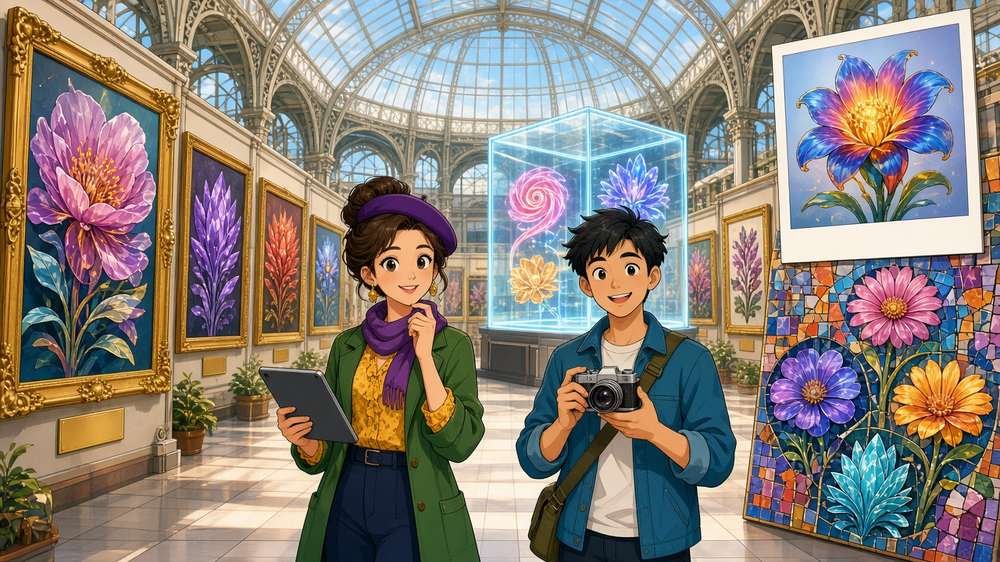
At Au Cube, Vincent Fournier’s Flora Incognita imagines how plants might mutate on other planets. The images look AI-made but were created with the long-established 3D software Houdini, framed with golden plaques like 19th-century botanical plates. And at Ruttkowski 68, François Hallard’s large Polaroids of flowers, titled “Conversations avec Claude”, gained a handwritten addition during previews – “(Monet) not IA” – after too many visitors assumed an AI connection.
Why it matters
That small correction sums up the moment. Photography is again negotiating what counts as real. Rather than building a wall between old and new, Paris Photo’s digital sector argues that digital experiments belong to a much longer history of manipulated, constructed and staged images – and that the best work makes viewers stop asking how a picture was made, and start looking.