When Frieze Abu Dhabi opens at Manarat Al Saadiyat from 19 to 22 November, the first thing many visitors will meet is a structure that seems to have travelled straight out of Lebanese history. The fair has given its very first Artist Award to the Lebanese artist Dala Nasser, whose new installation for the atrium is called Qubbat Duris.
A building made of other buildings
The title refers to a small 13th-century Muslim shrine near Baalbek, north-east of Beirut, and it is a remarkable piece of recycling. Its granite columns once belonged to Baalbek’s Roman Temple of Jupiter, while the limestone resting on top came from sarcophagi in an ancient necropolis. Two separate Roman sites, in other words, were taken apart and reassembled into a place of Islamic devotion. Nasser calls it a palimpsest that carries traces of everything from the second century AD to the present.
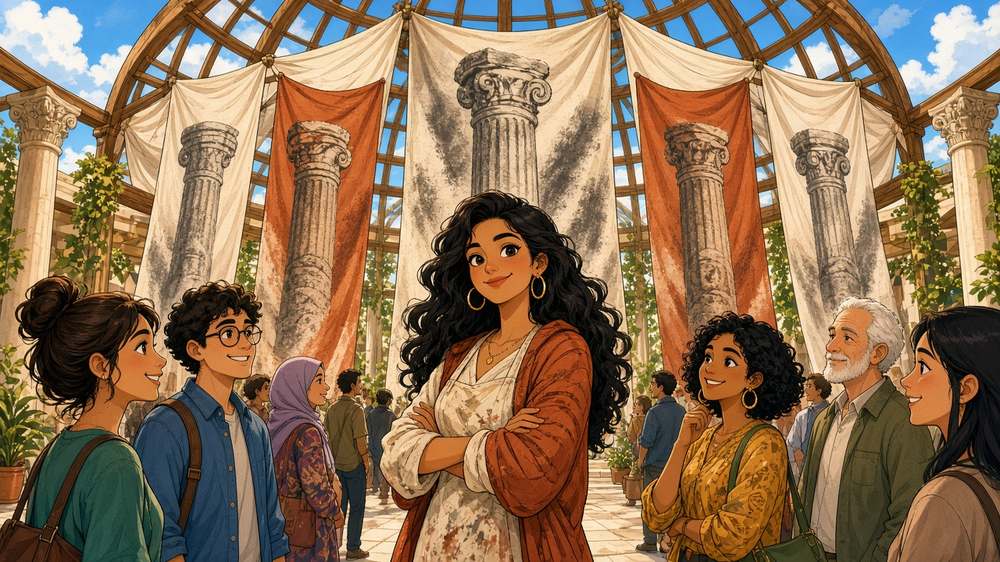
Her version translates that layering into materials. A timber framework will echo the shrine’s outline, and over it she drapes fabrics covered in charcoal rubbings taken from the surviving ruins, then worked with ash, raw clay and terracotta. It is a method she is known for: so-called archaeological frottage, in which the surface of an endangered site is literally pressed into the painting.
Against the Orientalist gaze
Nasser is aware that she is not the first to picture Qubbat Duris. The site appears in Orientalist painting and even as the backdrop of a widely shared photograph of the British traveller Gertrude Bell in costume on horseback. For the artist, those images say more about their makers than about the place. Earlier works such as Adonis River (2023) and Wedding at Qana (2024) also took on landscapes that European art history either exoticised or quietly turned into a version of the English countryside. Her goal, she explains, is to make paintings that are truthful to the land itself.
Evidence of damage
There is an urgent dimension too. The shrine was slightly damaged by an Israeli airstrike in October 2024, and already during the 2006 war a strike had dislodged one of its stones. Nasser is interested in how such a place keeps physical evidence of what it has endured, scars included. Rubbing its surfaces becomes a form of documentation at a time when much of Lebanon’s cultural heritage feels vulnerable.
For a fair in the Gulf, launching an artist award with a work so rooted in memory and loss is a clear statement. It places a young, fast-rising voice from the region at the literal centre of the event – and reminds collectors walking past that heritage is never just a backdrop.