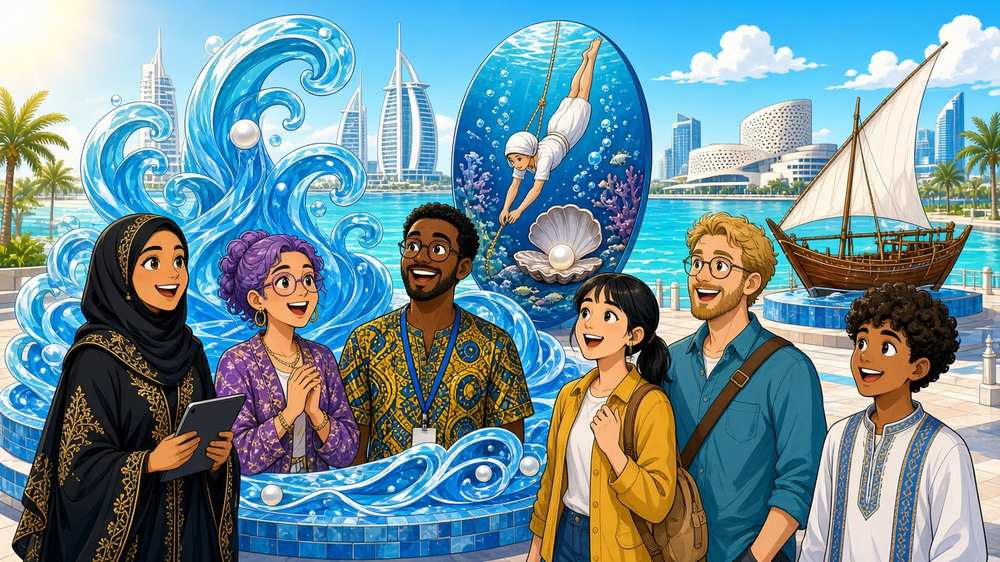
The Gulf has a new fixture on the international art calendar. On Saturday, 21 November 2026, Rubaiya Qatar opens its inaugural edition – the country’s first international, multidisciplinary contemporary art quadrennial. More than 120 artists from over 45 countries take part in exhibitions and public installations across Doha, and the programme runs until 30 April 2027.
Water as a connecting thread
The headline exhibition is called “Unruly Waters”. Director Sheikha Alanood Al-Thani explained to the Doha daily The Peninsula why the first edition is devoted to water: as a peninsula, Qatar has always been tied to the world by the sea – historically through the Maritime Silk Route, pearl diving and fishing, today through undersea internet cables and offshore gas fields. The exhibition traces those links between people, places and cultures.
The timing is symbolic too. The opening coincides with the fourth anniversary of the FIFA World Cup 2022, which the organisers describe as a moment of global exchange and national pride that they want to carry over into the cultural field: a platform “for dialogue and for discourse”, in the director’s words.
Four curators, more than 30 commissions
“Unruly Waters” is curated by Tom Eccles, Ruba Katrib, Shabbir Hussain Mustafa and Mark Rappolt and includes more than 30 newly commissioned works. According to Eccles, many participating artists spent time in Qatar, several works were produced directly in Doha, and others respond to the waters of the Gulf and, further south, the Indian Ocean. The goal, he said, was an exhibition that is welcoming and visitor-friendly while also offering critical, research-based and visually striking work.
Venues across the city
The main venue is ALRIWAQ Arts + Architecture. Further exhibitions take place at the Museum of Islamic Art, the Katara QM Gallery and Mathaf: Arab Museum of Modern Art, while new large-scale public artworks will appear in public spaces around the country over the course of the quadrennial.
Why four years instead of two?
The format sets Rubaiya apart from the many biennials around the world. Sheikha Alanood called it the first quadrennial “born after the digital age” – global in reach but rooted in Qatar. The four-year rhythm, she argues, gives artists more time for research and production, an “ebb and flow” that mirrors the theme of water itself.
With Frieze Abu Dhabi still running nearby until 22 November, the Gulf region is having an unusually dense art week. Rubaiya Qatar now has five months to show whether a slower, longer format can build a lasting audience – including among Qatar’s large and diverse resident population, whom the organisers want to reach through public programming.