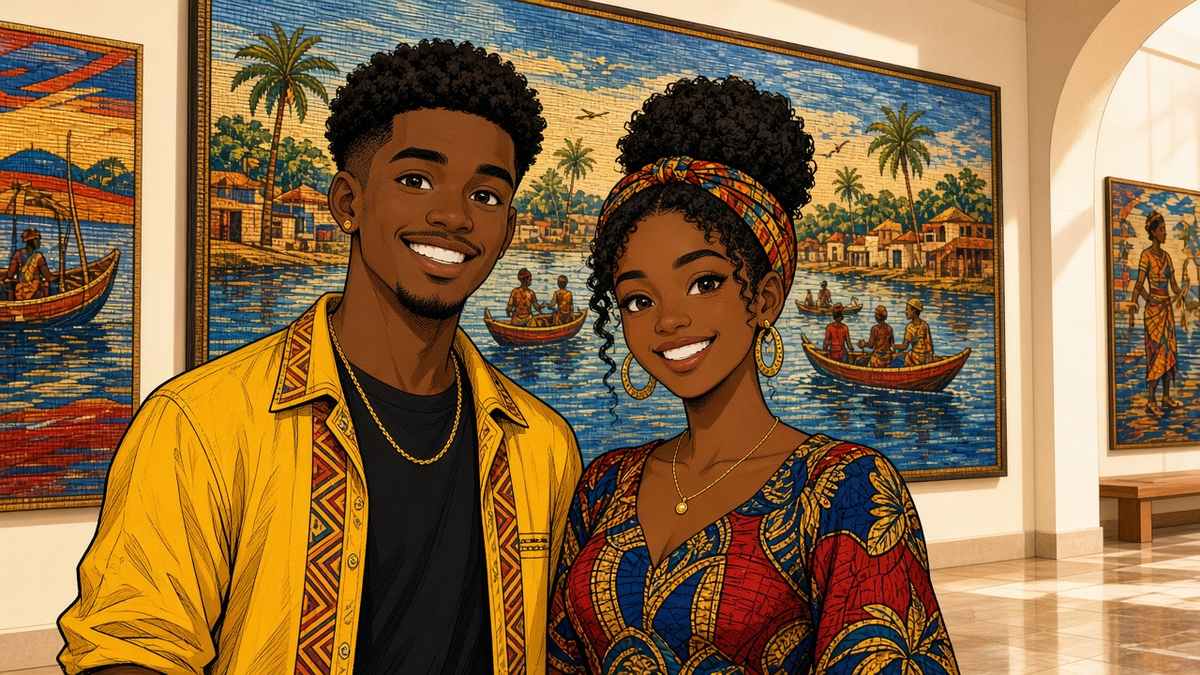
The Baltimore Museum of Art opened “Diedrick Brackens: lights at the end of the world” on 8 November 2026. Shown in the Contemporary Wing rotunda and third-floor galleries until 28 February 2027, the exhibition brings together around eleven large handwoven tapestries and sculptural weavings, several of them new, in which the artist turns to the Chesapeake Bay region and to histories of Black life and liberation.
Cotton as memory
Brackens, born in 1989 in Mexia, Texas, lives in San Francisco and works in Los Angeles. His textile practice combines techniques from West African weaving, Southern American quilting and European tapestry, and moves easily between abstraction and figuration. He works mainly with hand-dyed cotton — a material he chooses deliberately for its ties to the histories of enslavement, labour and migration in the United States. Drawing on his identity as a queer Black American, he interlaces history, myth and personal memory.
Lanterns, geese and wild horses
For this exhibition Brackens looked at the Chesapeake Bay in the second half of the 19th century as a place of both danger and possibility. The Underground Railroad, which guided self-emancipated people through Maryland towards freedom, forms the historical background for images of escape, evasion and self-possession. Lanterns, suns, moons and geese evoke navigation and endurance; wild horses recall the free-roaming herds of Assateague Island, which the artist frames as symbols of emancipation and self-determination. Domestic interiors appear as places of refuge. None of these motifs tells a fixed story — they work as fragments that invite visitors to build their own readings.
Tenderness and intimacy between Black men are central to Brackens’ work, offered as a counterpoint to histories of violence and erasure. Three major tapestries in the show follow the excitement of a young queer love as it begins. “It’s such a fraught time right now,” the artist has said. “All the things I care about are in trouble: landscape, gender, race, ritual, and spirituality that isn’t tied to a colonial past. But I still quest for those things and dream of them.”
Poetry on the walls
The Baltimore poet Joël Díaz has written new poems for the exhibition, displayed in long and short form on the gallery walls in dialogue with the textiles. BMA director Asma Naeem calls Brackens “one of the most fascinating artists working today” and says his new works connect national histories to the Chesapeake region, “offering our audiences new ways of understanding freedom, resilience, and belonging”. The exhibition is curated by Leila Grothe, former associate curator of contemporary art at the BMA, with curatorial assistant Oscar Flores-Montero. Brackens’ work is held by the Whitney, the Metropolitan Museum of Art, LACMA and the Studio Museum in Harlem, among others; in Baltimore it now speaks directly to the landscape and the history just beyond the museum’s doors.