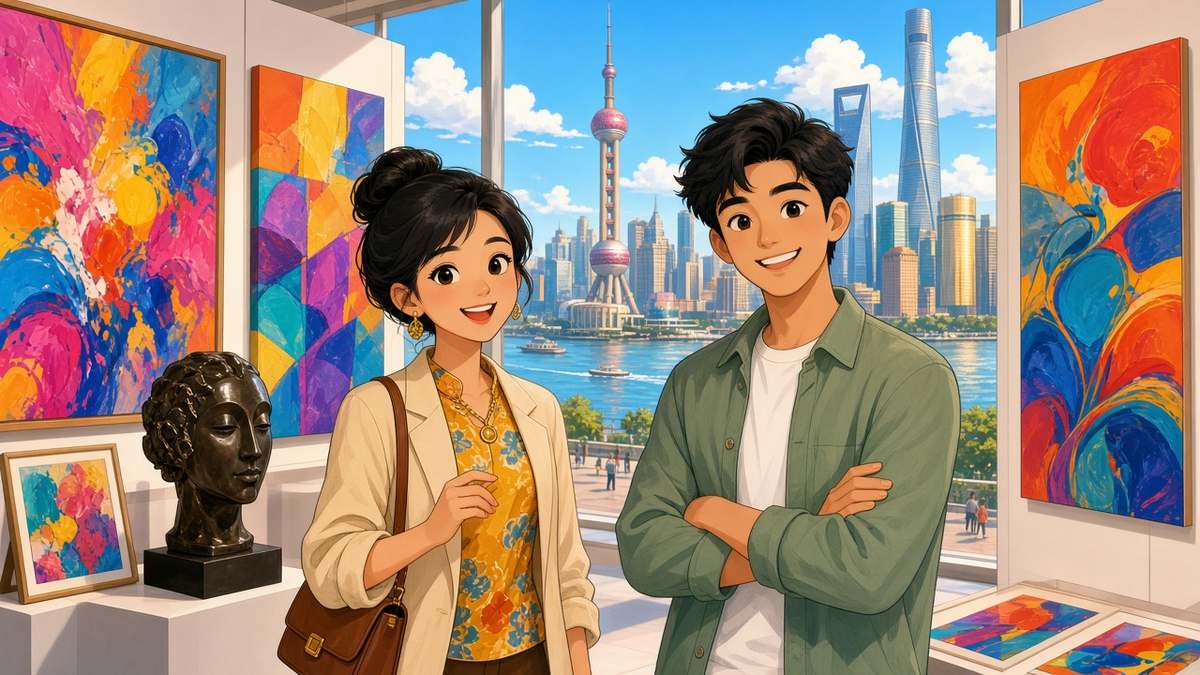
Every November, Shanghai turns into Asia’s busiest art address for a week. This year the mood is more measured than in the boom years, but far from gloomy. The city’s two leading fairs, West Bund Art & Design (10–15 November, 13th edition) and Art021 (14th edition, Shanghai Exhibition Centre), opened against a backdrop of slowing economic growth and fragile confidence in the Chinese market – and still reported solid early business.
Who is still buying
The message from dealers is consistent: the speculators have left, the serious collectors have stayed. Buyers are taking longer to commit to expensive works, while younger collectors increasingly look for artists of their own generation. Several galleries describe this as a healthier, if slower, market in which people buy what they actually want to live with.
The reported figures back that up. At West Bund, which brought together 85 galleries, Thaddaeus Ropac sold Megan Rooney’s large canvas That Sky (Atlas) (2026) to a Chinese foundation for £400,000, alongside works by Martha Jungwirth, Robert Longo and Han Bing – the last going to an Asian museum. Hauser & Wirth placed Louise Bourgeois’s bronze Point of Contact with a museum in Kuala Lumpur for $450,000, and sold Lee Bul’s Perdu XXXIII to a private collection in China for $260,000, plus a new George Condo for $200,000.
At Art021, with 111 exhibitors, mid-priced work by Chinese painters moved steadily: works by Xie Nanxing, Ju Ting, Liang Hao and Jiang Cheng sold in the range of a few hundred thousand renminbi, while younger artists found buyers at more accessible prices.
A museum bridge to Los Angeles
The most forward-looking element of the week is institutional. Art021 has launched an acquisition initiative with the Los Angeles County Museum of Art (LACMA), supported by Chinese collectors, to bring works by Asian and Asian-diaspora artists into the museum’s collection. It is a smart move for a fair that needs international relevance: it connects local patrons with a major Western museum and gives artists a path into a permanent collection rather than only into private homes.
New spaces despite the slowdown
Perhaps the clearest sign of confidence is that people are still opening galleries. Three new spaces launched this week: Hangzhou’s Inna Art Space opened a front room in the Lujiazui business district – the first significant gallery on the Pudong side of the river; the former director of the nonprofit Pond Society opened a space in the Suhe House cluster; and Taipei’s PTT Space opened an outpost in the M50 complex. Meanwhile, the boutique pop-up fair Hang Over is in its second year with 18 galleries from Tokyo, Seoul and Shanghai.
Our view
Shanghai no longer has the glamour it enjoyed before the pandemic, and the competition from Seoul, Hong Kong and newer fairs in the region is real. But the sheer density of openings, the steady institutional buying and the willingness of galleries to invest suggest that the city remains the gateway to mainland collectors. As one gallerist put it this week, the gallery business is a marathon, not a sprint – and Shanghai is settling into a longer, steadier pace.