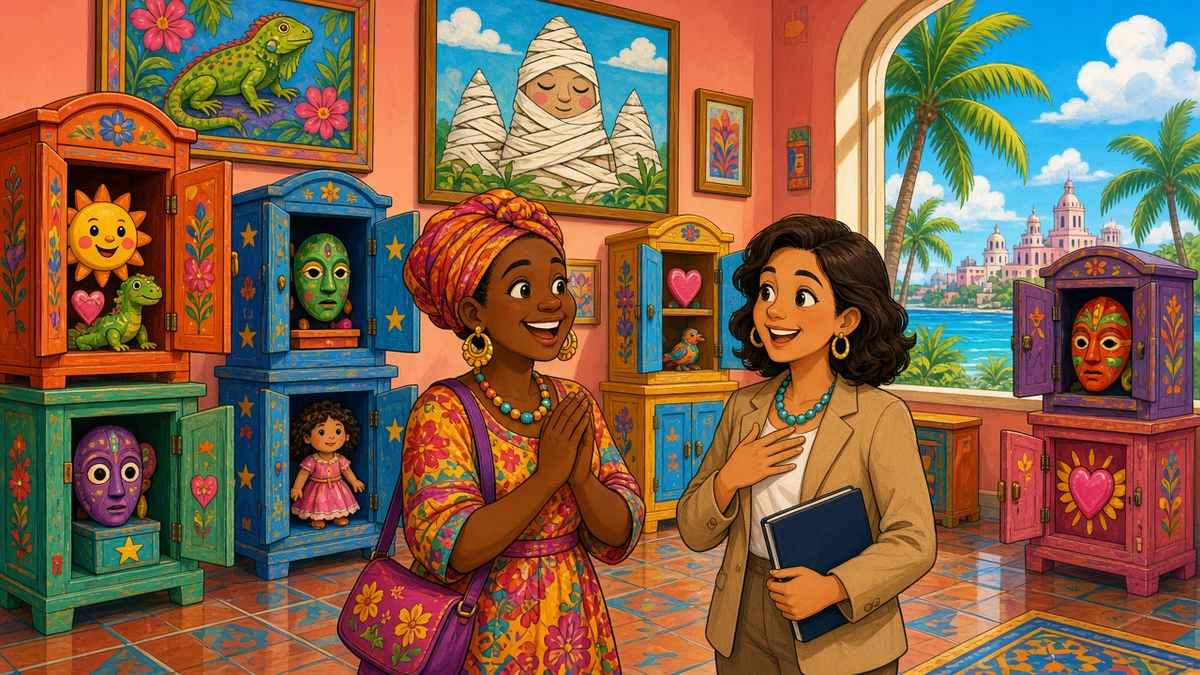
Some artists are rediscovered only after their deaths; Ofelia Rodríguez was in the middle of being discovered when she died. The Colombian artist (1946–2023) passed away weeks before her first major survey opened at Spike Island in Bristol in 2023. Three years later, Miami gives her the American stage she long deserved: “Ofelia Rodríguez: Psychic Jungle” opens today, 14 November 2026, at the Patricia & Phillip Frost Art Museum at Florida International University and runs until 25 July 2027. The museum calls it her first major solo exhibition in the United States.
From Barranquilla to East London
Rodríguez was born in Barranquilla on Colombia’s Caribbean coast, and the city never left her work. She studied fine arts at the Universidad de los Andes in Bogotá, then painting at Yale in the early 1970s and printmaking in New York. In the late 1970s she moved to Paris to study etching at the legendary Atelier 17, and in 1984 she settled in London, working from an East London studio for the rest of her life. Along the way she showed at the Queens Museum, the Havana Biennial and Colombia’s leading modern-art museums.
The “magic boxes”
In Paris she began the format that became her signature: “magic boxes” – small wooden cabinets with doors, painted in brilliant colours and filled with objects the way a shrine holds a relic. She collected the contents herself at street markets in Colombia and Mexico: carved and moulded masks, devotional pictures, horns, plastic toys. Combined, these ordinary things turn surreal, funny and slightly unsettling at once. Sometimes the boxes stand alone as sculptures; sometimes objects are fixed straight onto her canvases and painted around.
A private vocabulary
The Frost exhibition gathers four decades of painting, drawing, printmaking and assemblage. Visitors will meet a recurring cast of symbols: bandaged mountains, hybrid bodies, sacred and wounded hearts, toys and anatomical fragments, iguanas, caimans and cacti floating on flat fields of colour. Rodríguez played consciously with the clichés attached to the Caribbean – sensual colour, tropical exuberance, myth – and turned them into a critical, often comic look at cultural identity and gender roles. The museum stresses that her imagery resists exoticism rather than feeding it.
A title like Contemplando las divertidas emanaciones de mi cerebro (Contemplating the funny emanations of my brain, 2006) sums up the tone: introspective, ironic and generous. Works such as Peligro de Muerte (Danger of Death, 1998) show the darker edge underneath the bright surfaces. Many loans come from the artist’s estate and the Bogotá gallery Instituto de Visión.
A Latin American moment in Miami
The opening night is free and fittingly festive, with live cumbia. And it lands in a week when another Latin American artist, the Venezuelan Yanomami painter Sheroanawe Hakihiiwe, receives his first U.S. museum solo show at ICA Miami. Ahead of Art Basel Miami Beach, the city is making a clear case for artists from the South who were long overlooked by northern institutions – and Ofelia Rodríguez, with her boxes full of wonders, is one of the most delightful examples.