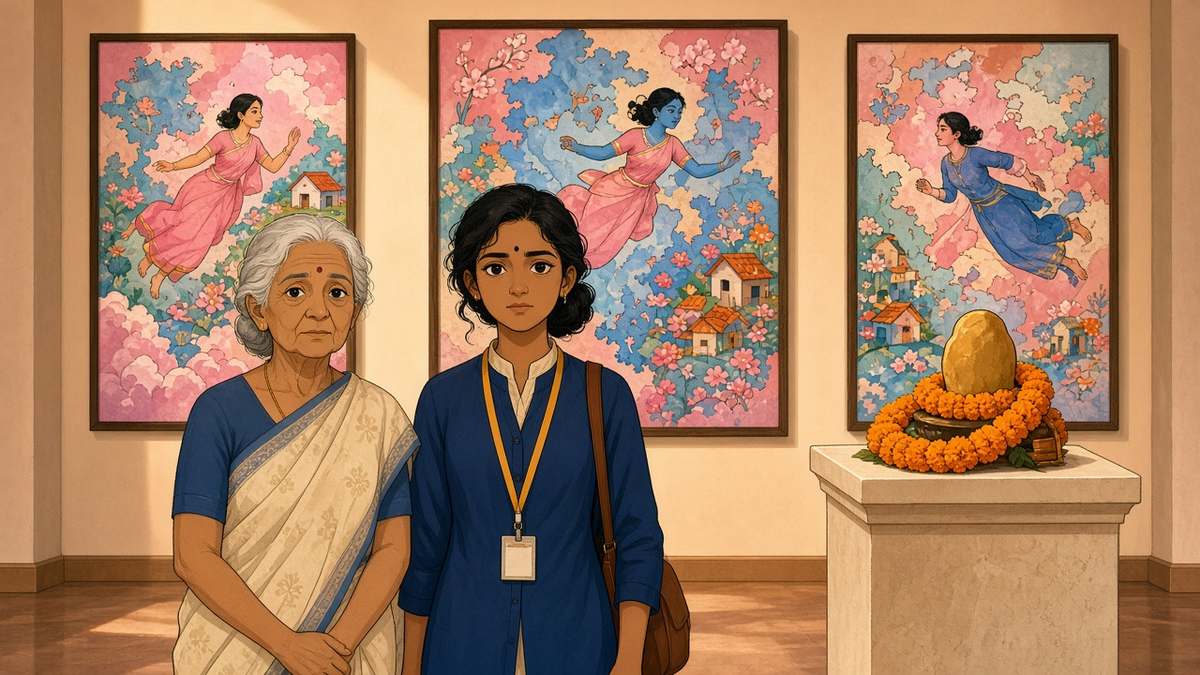
Indian art has lost one of its most singular voices. Arpita Singh died on Monday, 9 November, in New Delhi at the age of 89, as reported by the Tribune with confirmation from her husband, the painter Paramjit Singh. For more than sixty years she built pictorial worlds in which deities, mothers, men with weapons, little houses and flowers drift across surfaces that look like maps – worlds that were tender and unsettling at the same time.
A childhood marked by Partition
Born in 1937 in West Bengal, Singh moved to Delhi in 1946. A year later came Partition, and with it scenes that stayed with her for life: she once recalled watching from a balcony as a man was killed in the street below. She graduated from the art school of Delhi Polytechnic in 1959, taught by modernists such as Biren De and Sailoz Mookherjea, and found early inspiration in Der Blaue Reiter, Kandinsky, Klee and Chagall.
From dots and dashes back to figures
Her career did not follow a straight line. Early success with the influential Bombay dealer Kekoo Gandhy was followed by doubts about her deliberately naive figuration. In the 1970s and 1980s she turned to abstraction – austere, almost colourless sheets built from dots and dashes. By the end of the 1980s she returned to the figure, now with a richer palette and a fearless approach to narrative.
Her best-known painting, Devi Pistol Wali (1990), today in the Museum of Art & Photography in Bengaluru, shows a shrouded, many-armed female figure pointing a gun at a man holding a sword. It is often read as a response to violence against women in India, but Singh resisted such neat explanations. Current events, she said, entered her paintings the way light becomes colour and a breeze becomes movement. She also rejected the label “dreamlike”: her figures do not float, admirers argued, because in her pictures gravity simply does not exist. “I control the law,” Singh once said of these worlds. “I’m the master.”
Late international recognition
At home she had long been a leading figure, honoured with the Padma Bhushan and celebrated with a retrospective at the Kiran Nadar Museum of Art in New Delhi in 2019. Abroad, recognition came late. Her work appeared in the Centre Pompidou’s large survey of abstraction by women and at the Gwangju Biennale in 2021, and at the Kochi-Muziris Biennale in 2022. The real breakthrough in the West came only in 2025, with a survey at the Serpentine Galleries in London – which Singh, characteristically unimpressed, simply called “a prestigious thing for me”.
Anyone who wants to see her work now has a chance in New York: Talwar Gallery is currently showing Singh’s paintings through 27 February. Her legacy is a body of work that refuses easy comfort, holding beauty and brutality in the same frame – and asking viewers to keep looking.