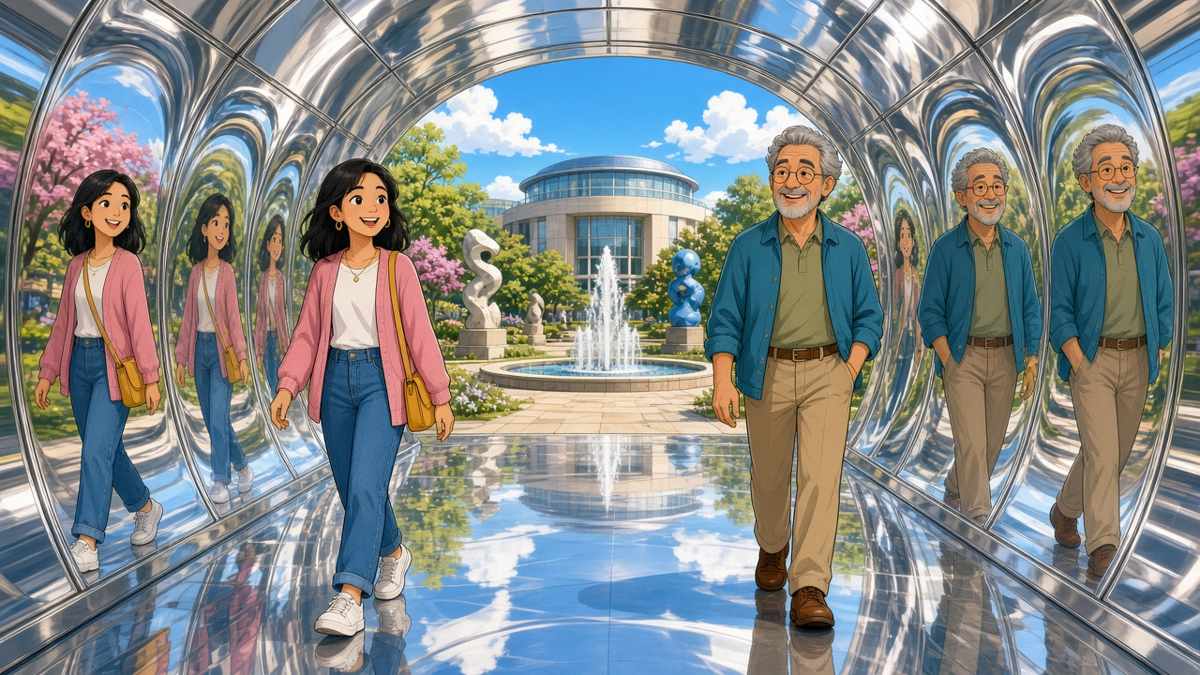
For decades the underground passage linking the Hirshhorn Museum’s Sculpture Garden with the museum plaza in Washington was simply shut. Now the Japanese artist-architect Hiroshi Sugimoto has turned it into a work of art in its own right. The Smithsonian unveiled Passage of Reflectance (2026) this week, a site-specific commission that reopens the tunnel as a light-filled pedestrian route.
Two steel wings and an imagined meeting point
The installation consists of two parabolic stainless-steel “wings” lining either side of the passage, each roughly 90 feet (about 27 metres) long and 8 feet high. Their curves are calculated so that they would meet, in theory, at the centre of Gordon Bunshaft’s famous cylindrical museum building. Walking through, visitors see themselves stretched, multiplied and softened in the mirrored walls — an effect the museum compares to an Impressionist painting in motion.
That is typical of Sugimoto, whose practice has long translated mathematical principles into sculptural form. His point is a quiet one: the laws that shape the physical world are usually invisible, and art can make them felt for a moment. Seen from the garden’s new entrance on the National Mall, the steel also catches the central water feature and the surrounding sculptures, so the passage doubles as a welcome mat.
Part of a larger garden makeover
Passage of Reflectance is one element of Sugimoto’s wider revitalisation of the Sculpture Garden, a project that has been discussed and debated in Washington for years. The redesigned garden opens to the public on Saturday, 31 October, at 11 a.m., and the tunnel will be one of the first things many visitors experience.
For a museum built around modern and contemporary art, turning a piece of infrastructure into an artwork is a statement: the route into the collection becomes part of the collection. It also solves a practical problem, reconnecting two halves of a campus that had been cut off from each other.
Why it matters
Museums everywhere are rethinking how people arrive, wander and linger. Sugimoto’s mirrored corridor suggests that the in-between spaces — stairwells, ramps, underpasses — deserve as much design attention as the galleries. Expect plenty of selfies; the artist seems to have planned for that, too.