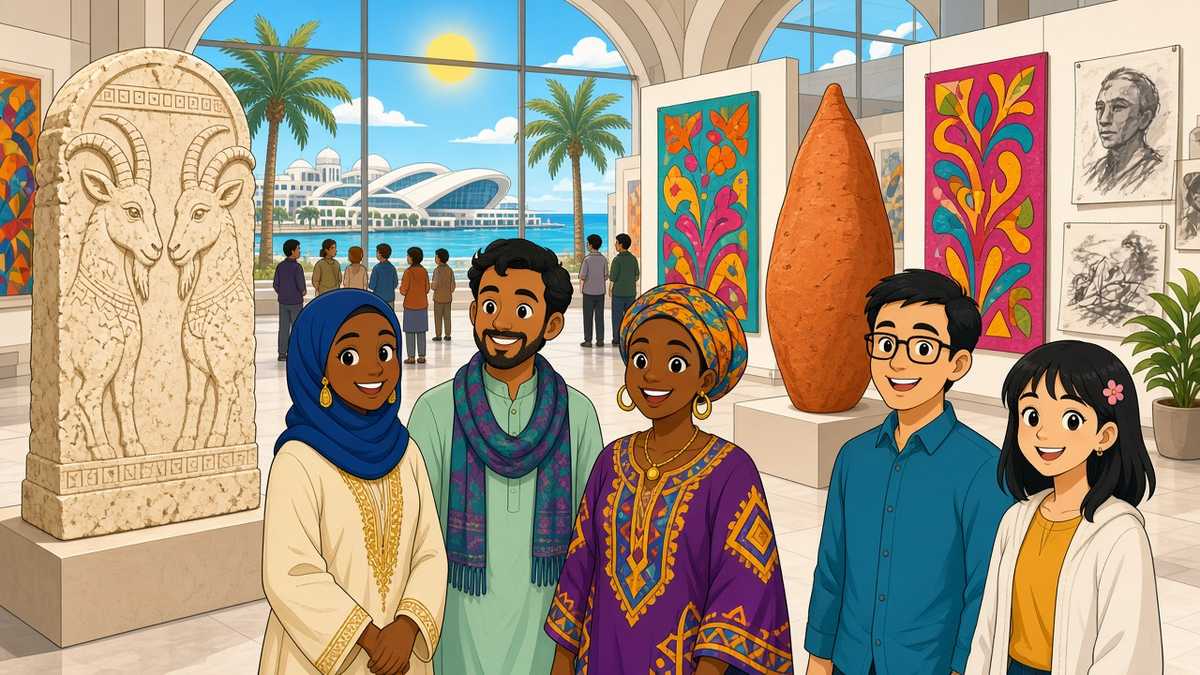
Abu Dhabi now belongs to the Frieze family. On 19 November 2026, Crown Prince Sheikh Khaled bin Mohamed bin Zayed opened the inaugural Frieze Abu Dhabi at Manarat Al Saadiyat. The fair, organised by the Department of Culture and Tourism – Abu Dhabi together with Frieze, runs until Sunday, 22 November. It joins Frieze’s network in London, New York, Los Angeles, Chicago and Seoul, and replaces the city’s long-running fair Abu Dhabi Art, which had seventeen editions.
Smaller and more focused
According to The National, the organisers count 89 exhibitors from 64 cities in 37 countries and regions – fewer than the 142 galleries at last year’s Abu Dhabi Art, but with more concentrated presentations. Global names such as Gagosian, Pace and Thaddaeus Ropac show next to galleries from the Arab world, Africa, Asia and Europe. The fair has four sections: Galleries, Focus for younger galleries, Global Futures with solo presentations, and Frieze Masters Abu Dhabi, which looks at centuries of cultural exchange across the Indian Ocean. Works range from the Sudanese modernist Ibrahim El-Salahi to the Indigenous Australian artist Emily Kam Kngwarray and the American textile artist Sheila Hicks.
A 2,000-year-old homecoming
One of the first big deals was done before the doors opened. The London antiquities dealer David Aaron sold the Dedicatory Stele of Faysat – an alabaster monument from the ancient kingdom of Qataban in today’s Yemen, made in the late first century BC – to a private collector for a seven-figure sum. It shows a woman holding ears of grain, decorated with nine ibex heads. Only around 30 such monuments are known, and it is the stele’s first return to the Arabian Peninsula in almost 70 years. The gallery says it checked provenance against databases including Interpol and the Art Loss Register.
Sweet potatoes and slow textiles
Contemporary art from the region gives the fair its personality. The Emirati conceptual artist Abdullah Al Saadi presents works from his Naked Sweet Potato series: for ten years he has studied the shapes of the fandal, as the vegetable is called locally, in drawings, clay, stone, jewellery, furniture and even an alphabet. Cairo’s Gypsum Gallery shows Dina Danish and Jean-Baptiste Maitre, who use khayamiya, a traditional Egyptian appliqué technique, to depict fleeting images of the news cycle such as handshakes and microphones.
A new chapter for the Gulf
Abu Dhabi sees the fair as part of its strategy to build a cultural economy, alongside the museums on Saadiyat Island. Whether Frieze can create the same energy here as in London or Seoul will show in the coming years. The first edition already makes one thing clear: the art world’s map is moving, and the Gulf is firmly on it.