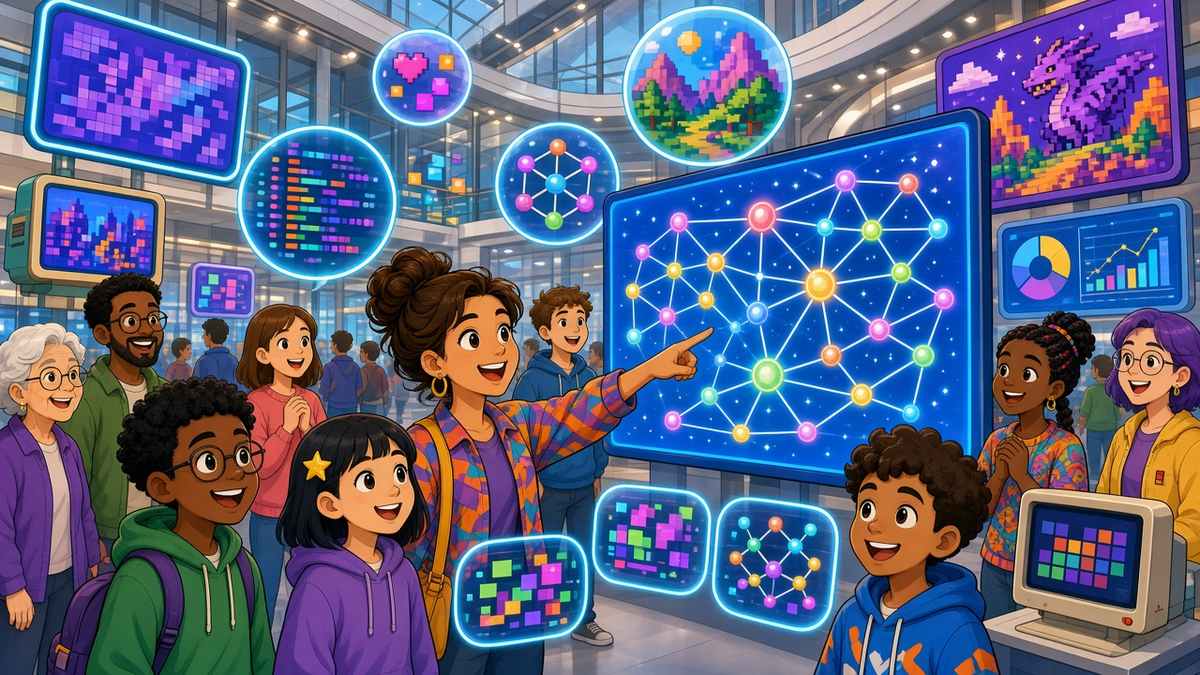
Art made for the browser rarely gets a museum floor of its own. From 21 November 2026, the Whitney Museum of American Art in New York is changing that with “artport: A History of Internet Art”. The exhibition runs until 28 March 2027, both online and in the museum’s sixth-floor galleries, and brings together more than 100 works.
A pioneering portal turns 25
The occasion is an anniversary: artport, the Whitney’s portal for commissioning internet art, launched in 2001 – at a time when few major museums took art made with code and networks seriously. Over a quarter century it has become one of the most important institutional homes for the genre. The anniversary show spans code-based works, gaming environments, nonlinear narratives and, most recently, AI-driven art.
Code as a creative medium
Among the featured artists is Golan Levin, professor at Carnegie Mellon University’s School of Art, who is represented with two artport commissions. Axis (2002) was originally made for the landmark artport exhibition CODeDOC, which invited artists to treat software code itself as a form of creative writing and an artistic medium.
The second work, The Dumpster (2006/2026), was created with Kamal Nigam and Jonathan Feinberg and co-commissioned by artport and Tate. The interactive online visualisation attempts to show a slice through the romantic lives of American teenagers, drawn from their online writing. For the anniversary, Levin updated it so that it runs in modern web browsers without emulation.
The preservation problem
That detail points to the central challenge of the genre. Internet art ages fast: plug-ins disappear, browsers change, servers go offline. Keeping such works alive often means rewriting or emulating them – a question of conservation that museums are still learning to answer. By showing early pieces next to recent ones, the Whitney exhibition also documents how much of this history depends on active care.
Online and offline
Fittingly, the exhibition is not confined to the building. Visitors can explore it in the galleries or on the web, where most of the works were meant to be experienced in the first place. For anyone curious how artists have used the internet as material over the past 25 years – from early code poetry to AI – this is one of the most comprehensive overviews a museum has assembled.