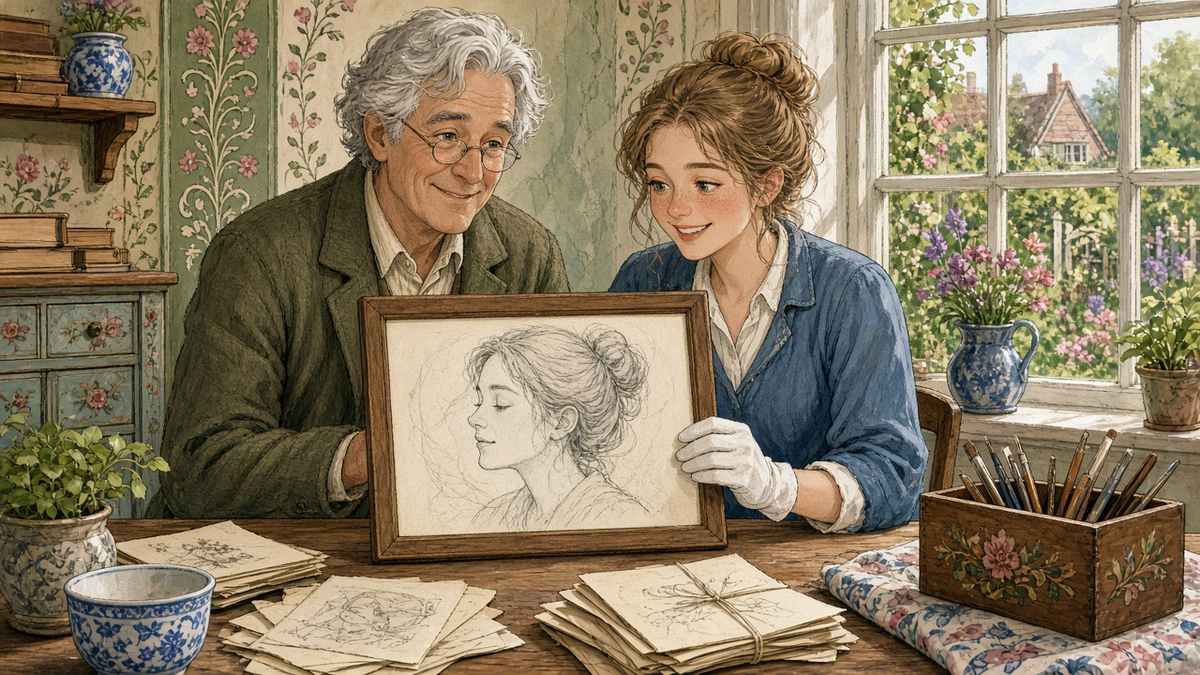
Just ahead of a major Bloomsbury exhibition in London, a small and deeply personal drawing has come to light. A previously unknown portrait of Vanessa Bell by Duncan Grant, believed to be the last he ever made of her, has been discovered and donated to Charleston, the couple’s former farmhouse home and studio in East Sussex.
A few lines at the bedside
The drawing, in soft pencil and biro on paper, shows Bell’s head in profile, her eyes closed and her head resting on a pillow. It is viewed from the side and slightly below, as if Grant were sitting next to her bed. Nothing of the bold colour and pattern for which both artists are known is present here; just a handful of lines describe a face at rest.
The sheet had remained among family papers for more than sixty years and was unknown to scholars. It turned up during preparations for Tate Britain’s “Vanessa Bell & Duncan Grant: Inside Bloomsbury”, which opens on 12 November 2026. Until now, a charcoal drawing from earlier in 1961 was considered Grant’s final portrait of Bell.
A puzzling date
There is one riddle. The drawing is inscribed 14 April 1961. Bell died at Charleston on 7 April, aged 81, and was buried on 12 April at St Peter’s Church in nearby Firle. Darren Clarke, head of collections and research at Charleston, thinks Grant added the date later from memory. In his final years Grant and friends went through the large body of work in his studio, dating pictures so they could be recorded, exhibited and sold, and those dates are not always reliable. Everything about the drawing itself, Clarke says, suggests someone sitting quietly beside the bed and drawing a face he had known for half a century.
Fifty years of portraits
Grant, who lived on at Charleston until his death in 1978 and was buried beside Bell, painted and drew her throughout their shared life. In 2019 a full-length portrait he made of her in 1915, at the start of their relationship, was accepted for the nation and allocated to Charleston. The new drawing now marks its end.
The work enters Charleston’s collection as part of its “50 for 50” campaign, which aims to secure fifty major Bloomsbury works by 2030. It will not appear in the Tate show, although a small reproduction is expected in the catalogue. After documentation and conservation, it goes on public display in the house for the first time in May 2027, when Grant’s studio reopens following a £470,000 conservation project; the studio’s contents are currently on loan to Tate.