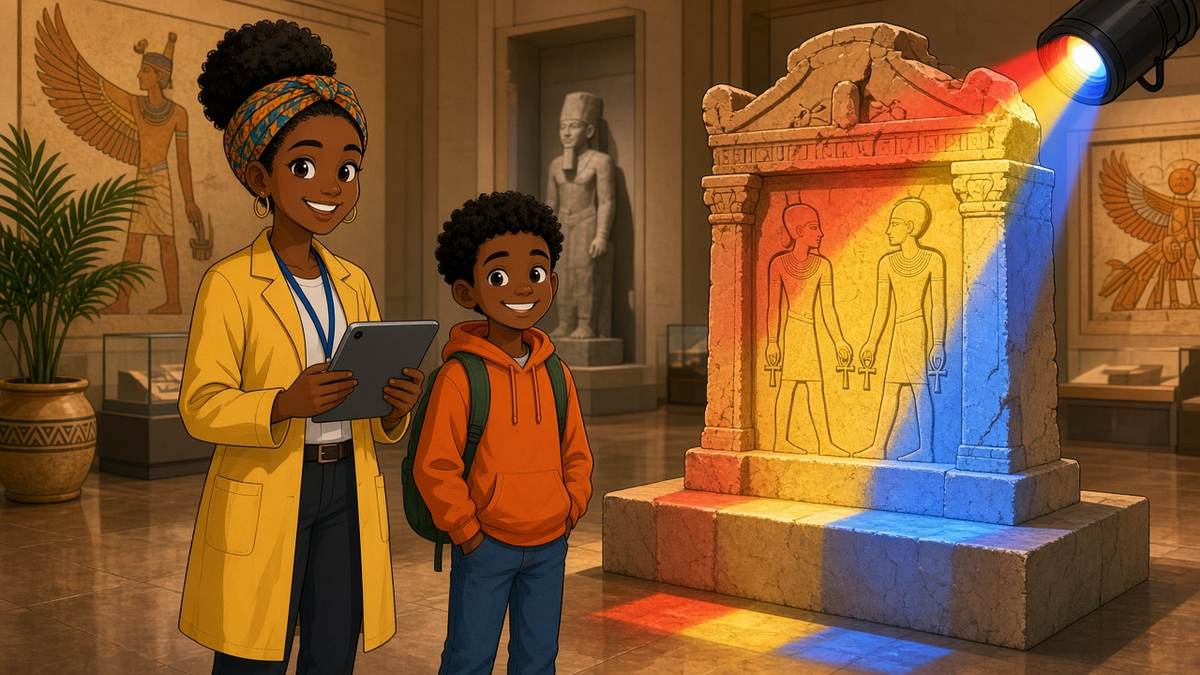
For visitors to Oxford, the Shrine of Taharqa has always looked like what it is today: carved sandstone in the colour of dry earth. Its makers saw something very different. New research at the Ashmolean Museum has recovered the shrine’s original palette, and from 13 November 2026 those colours will be projected back onto the stone.
A Kushite king’s building in Britain
The shrine was built in the 7th century BC at Kawa in what is now northern Sudan, under Taharqa, one of the kings of Kush who also ruled Egypt as pharaohs. It is described as the only freestanding building in Britain that dates back to the time of the pharaohs. Its carved reliefs show Taharqa with the gods of Memphis and Heliopolis and with Amun-Re, both in his Theban form and as a local deity of Gematen, the ancient name of Kawa. Taharqa appears in two guises: as an Egyptian pharaoh wearing the Double Crown, and as a Kushite king with ram’s-head ornaments and the Kushite crown topped by two cobras.
Colours the eye can no longer see
Originally the sandstone blocks were plastered and brightly painted. Some red paint still survives in the crevices of the carvings, but most of the colour has faded beyond what the naked eye can detect. Researchers therefore combined microscopic analysis with hyperspectral imaging, a technique that joins photography and spectroscopy and records how a surface reflects light across many narrow wavelengths. This revealed traces of yellow and of Egyptian blue, a brilliant synthetic pigment used to paint divine figures.
Egyptian blue is especially suited to this kind of detection because it gives off a faint glow in the near-infrared that cameras can register even when nothing is visible to people.
Light instead of paint
Rather than repainting the fragile monument, the museum has chosen a digital projection based on the research data. The installation will be free for everyone visiting the Ashmolean’s Ancient Egypt and Sudan galleries. It follows a wider trend in museums, from Greek temples to Roman sculpture, of showing that the ancient world was far more colourful than the pale stone suggests.
The project is also a reminder of Kush, the African kingdom whose rulers once governed Egypt, and whose history is often told only as a footnote to the pharaohs. Seeing its shrine glow again in red, yellow and blue may help change that.