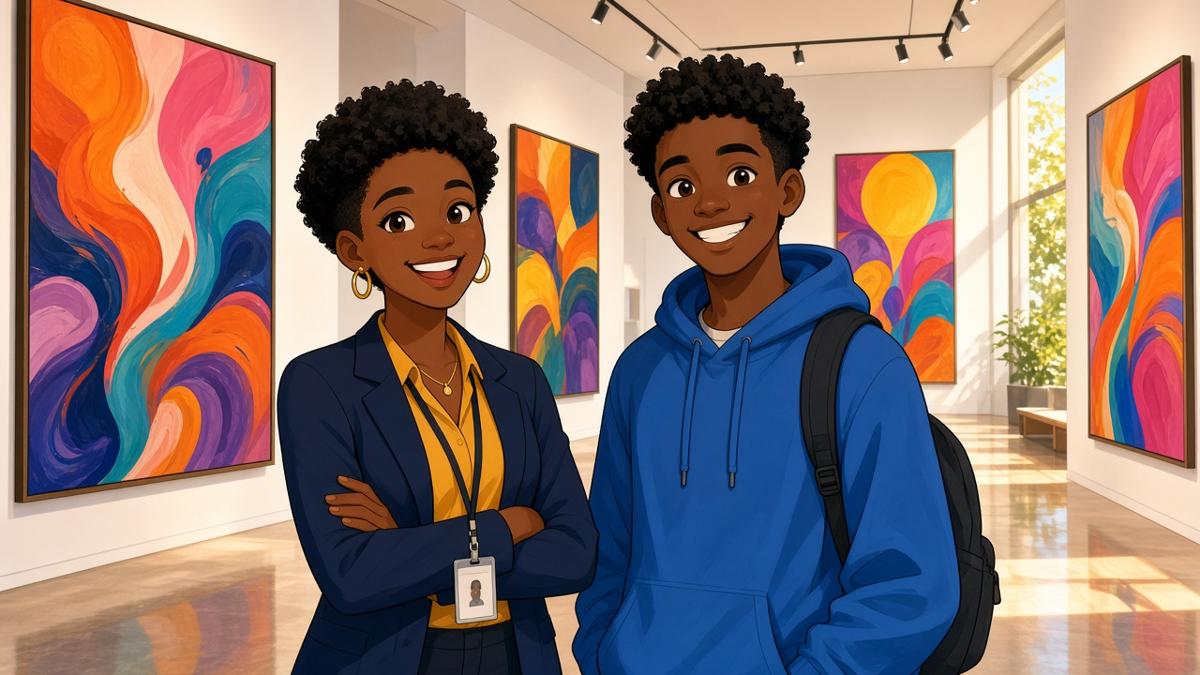
On 5 November 2026, MoMA PS1 in Queens opens “Hard Art”, a major survey of abstract painting by Black artists in the United States from 1969 to today. The exhibition runs through 15 March 2027 and brings together work by more than forty artists, placing historical figures of the 1970s next to some of the most closely watched practices of the past decade.
A title with a history
The show’s title comes from Peter Bradley’s description of The DeLuxe Show, the landmark 1971 Houston exhibition that brought abstract painters together across racial lines in a former movie theatre. “Hard Art” takes that phrase as a point of departure: not only for the toughness of the work on view, but for the long struggle to have Black abstraction treated as central rather than peripheral to American modernism.
Organised by Connie Butler, Agnes Gund Director of MoMA PS1, with Sheldon Gooch, the exhibition is accompanied by essays and a publication. Major support comes from the Terra Foundation for American Art.
Across generations
The historical core includes artists who redefined painting and sculpture in the 1970s and after: Frank Bowling, Mark Bradford, Peter Bradley, Barbara Chase-Riboud, Ed Clark, Melvin Edwards, Jennie C. Jones, Joe Overstreet and Raymond Saunders, among others. Their work — poured colour fields, cut and welded forms, sonic references, collage and improvisation — already challenged the idea that abstraction was a closed, white chapter of art history.
Alongside them stand recent and mid-career practices that push those languages further: Aria Dean, Torkwase Dyson, Nikita Gale, Suzanne Jackson, Rindon Johnson, Caroline Kent, Carolyn Lazard, Eric N. Mack, Charisse Pearlina Weston, SoiL Thornton and others. The conversation between generations is the exhibition’s real subject: how material experiment, architectural space, sound, fabric and light keep rewriting what “abstract” can mean.
Why it matters now
Surveys of Black art in US museums have often favoured figuration and narrative. “Hard Art” insists that abstraction was never a side road. For Queens audiences — and for anyone following how institutions rewrite their canons — MoMA PS1’s winter programme offers a rare chance to see that argument hung, room by room, across more than five decades.