Lagos is famous for traffic, trade and relentless hustle. For a few days each November, it also becomes West Africa’s art capital. The 11th edition of ART X Lagos, the region’s largest art fair, ran from 5 to 8 November at the Federal Palace Hotel on Victoria Island, anchoring a city-wide art week of exhibitions, talks, music and film. Thousands of visitors came to look, meet and collect – many in bold Afrocentric fashion that led one visitor to joke about Nigeria’s own “Met Gala”.
A new chapter, rooted in the old
This year’s theme, “A New Chapter, A New Decade”, looked back to the pioneering generation of Nigerian artists, architects, educators and thinkers who shaped the country’s modernism. Founder Tokini Peterside framed that generation as proof that innovation does not require abandoning inheritance: histories, she argued, are not just things to preserve but living sources of knowledge for what comes next.
The sound of Badagry
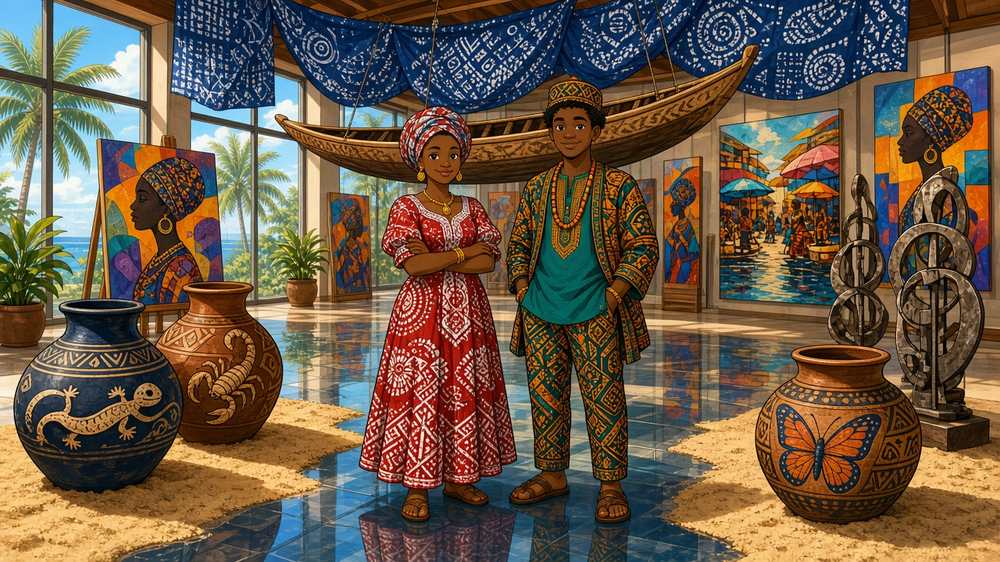
One of the most talked-about works was Ndidi Dike’s installation Residues of Past Encounters II: a wooden canoe suspended above a reflective glass surface edged with sand, beneath Adire-style fabric printed with silhouettes of tightly packed bodies. Sand and the soft sound of waves come from Badagry, the coastal town that was once a notorious departure point for enslaved West Africans. Dike links that history to today’s dangerous migration routes across the Sahara and the Mediterranean – inviting viewers to imagine leaving home without knowing whether they will return.
Honouring Ladi Kwali
The exhibition Beyond the Vessel, curated by Jareh Das, celebrated Ladi Kwali, the Gbari potter from the village of Kwali near Abuja whose work, decorated with scorpions, lizards and butterflies, took her from local renown to museum collections worldwide – and onto Nigerian currency. Das sees her as a reminder that culture can be drawn from within, even from something as familiar as pottery.
Healing, memory and the next generation
Elsewhere, Adeniyi Adewole’s fibreglass sculpture Breath Beneath the Waters traced his path out of depression towards calm, and a Kampala gallery, Afriart, showed a Ugandan painting made with coffee. Joel Benson’s documentary Mothers of Chibok followed families still grieving daughters abducted by Boko Haram in 2014 – a sober counterpoint to the festive atmosphere. Beyond the fair, Mercy Imiegha’s group show Every House Remembers and a citywide tour by the G.A.S. Foundation spread the programme across Lagos.
Perhaps most important for the future: more than 750 schoolchildren took part in the fair’s education programme. For many, it was a first encounter with contemporary art – and, as Peterside put it, a chance to see creativity not as something distant but as something they can join.