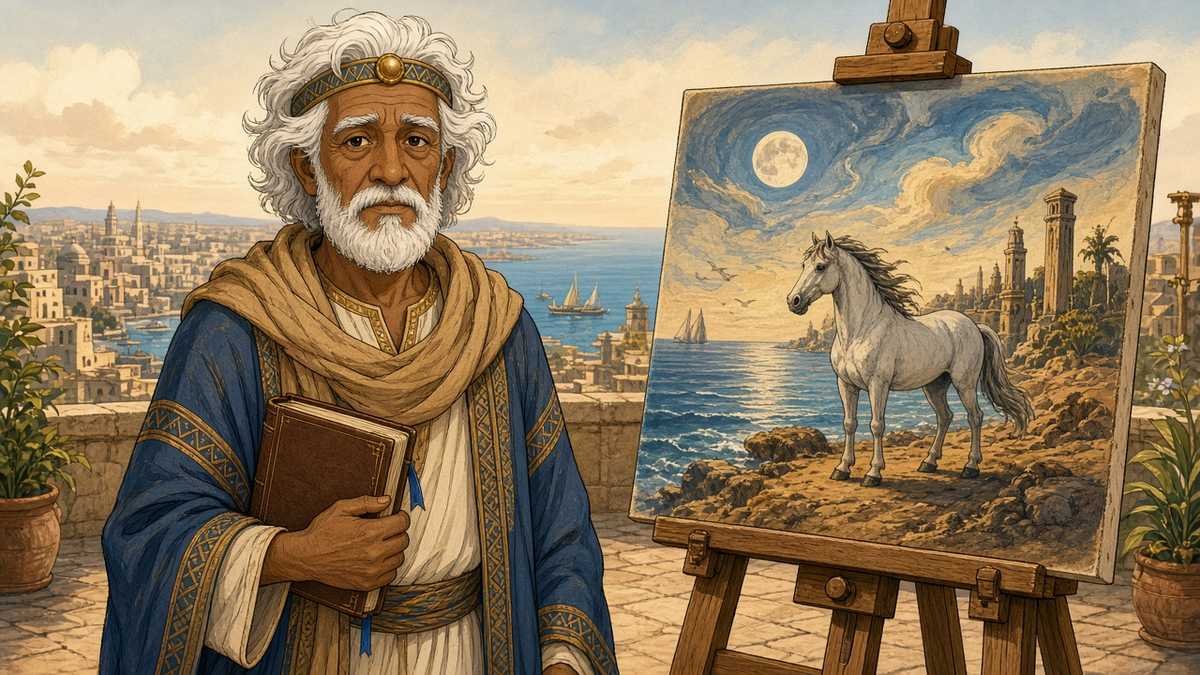
The art world has lost one of the last links to Egyptian modernism’s founding generation. Ahmed Morsi, the Egyptian-born painter and poet who lived in New York for half a century, died on Wednesday, 18 November 2026, in Cairo at the age of 96. His daughter Sherine Morsi confirmed that he died of natural causes, writing that his understanding of “our shared humanity, in all its complexity, fragility, and beauty” found expression in both his art and his words.
From the Alexandria School to New York
Morsi was born in Alexandria in 1930. As a young man he studied drawing with the Italian artist Silvio Bicchi and belonged to the so-called Alexandria circle drawn to Surrealist imagery around the Second World War. In Egypt and Iraq during the 1950s and 1960s he developed the style that would remain his own: a poetic figuration in muted tones, quiet and slightly fantastical, peopled by solitary figures, horses and dreamlike horizons.
In 1974 he moved to New York, where his wife Amany Fahmy had become head of the United Nations Arabic Translation Service. She also translated some of his writing, which ranged from poetry to criticism. Morsi was a founding force behind Galerie 68, an influential Cairo journal devoted to Arab modernism.
A homeland that is not on any map
Exile shaped his work; he once said he had been “displaced most of my life”. Yet the Alexandria in his paintings was never simply the city on the Mediterranean. In a 2021 interview he insisted that his Alexandria was “a city of my youth and also myth and legend” – and added: “Don’t look for this Alexandria on your maps.”
For Morsi, painting and poetry were two sides of the same search. “Poetry and painting may be separate media used in a constant attempt to understand the Self, but my vocabulary on paper and on canvas is one,” he said.
Late recognition
Although he worked for more than seven decades, wider international attention came late. In 2021 he was included in MoMA PS1’s survey “Greater New York”, and in 2024 Adriano Pedrosa brought his work to the main exhibition “Foreigners Everywhere” at the Venice Biennale – a fitting stage for an artist who spent his life between places. He was represented by the gallery Salon 94.
His own description of his art may serve as an epitaph: “I am not building a world – for me, that world, my world, exists and has existed since time immemorial … In mine, the senses are free.”