London’s city museum has a new address – and a new name. Closed at London Wall near the Barbican since December 2022, the institution formerly known as the Museum of London opens to the public on Saturday 28 November 2026 as London Museum, now housed in the historic General Market at Smithfield in the City of London. The project has cost £437 million and took ten years from first plans to opening, which coincides with the museum’s 50th anniversary.
A Victorian market brought back to life
The General Market opened in 1883 to designs by Sir Horace Jones, the architect of Tower Bridge and Leadenhall Market. After more than a century of trade it was shut in the 1990s and fell into disrepair. The restoration was led by Stanton Williams with collaborating architect Asif Khan and conservation architects Julian Harrap. Original market signs, the wrought-iron columns that carry the huge roof and a ring of heritage shopfronts have been kept; the shopfronts will house independent organisations, so far including a pub and the children’s arts charity A New Direction. The museum says the building is set to reach a BREEAM “Outstanding” sustainability rating.
Funding came from a partnership of the museum, the City of London Corporation – the largest principal funder – and the Mayor of London, together with philanthropic partners such as Bloomberg Philanthropies, the Goldsmiths’ Foundation, the Linbury Trust and the National Lottery Heritage Fund. The City Corporation expects around two million visitors a year.
Three kinds of time
Rather than a single chronological route, the museum is organised around time. The entrance, a former covered street called Real Time, uses animated data screens to show London in the present moment – from its pubs and bees to Londoners’ moods. It also holds one of Banksy’s 2024 animal works, the Piranhas police sentry box, and a clock tower with the last bell cast at the Whitechapel Bell Foundry, which will ring the museum open every day.
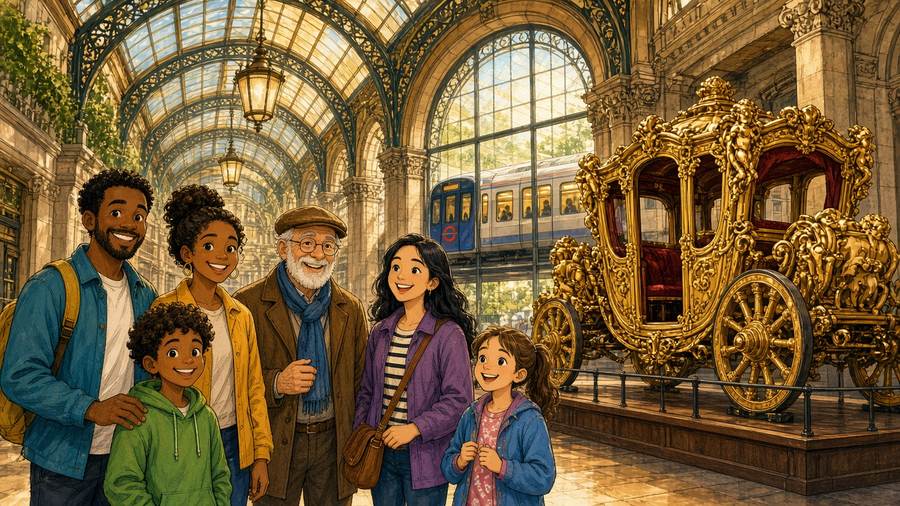
Our Time, set on the bright former trading floor, is conceived as a social hub about the city in living memory. Its anchor objects include the 1757 Lord Mayor’s State Coach, the Buckingham Palace switchboard, decommissioned in 1970 and shown for the first time, and Syd’s Coffee Stall, a century-old East End fixture that will serve free hot drinks on Tuesdays. Twenty signs from nightclubs, dance halls and shops celebrate the places where Londoners meet, and a soundscape by the electronic musician Scanner fills the hall.
Below ground, Past Time sits at Roman street level and covers 2,000 years of urban history. Highlights include the Cheapside Hoard of Elizabethan and Jacobean jewellery, Emmeline Pankhurst’s hunger strike medal, Roman writing tablets from the Bloomberg Collection, a Roman wall painting reassembled over 400 hours, Anna Pavlova’s Dying Swan costume and the smashed bass guitar from the cover of The Clash’s London Calling, lent by Paul Simonon. And yes, a chunk of the notorious Whitechapel fatberg. A six-metre window lets visitors watch Thameslink trains pass through the galleries.
More to come
The opening is only the first phase. Underground vaults rediscovered during construction in 2019 will host the free exhibition Londinium: the making of a Roman city from spring 2027, and the neighbouring 1960s Poultry Market, with temporary exhibition spaces, a learning centre and a collection store, is due in 2028. The permanent galleries are free; the museum will stay open until 11pm on Fridays and Saturdays.
Director Sharon Ament describes the result as the city’s story “in all its grit and glitter”, created with more than 100,000 people. Whether its mix of serious history, pop culture and late-night programming wins over Londoners will become clear from Saturday – but few museums anywhere have reinvented themselves on this scale.