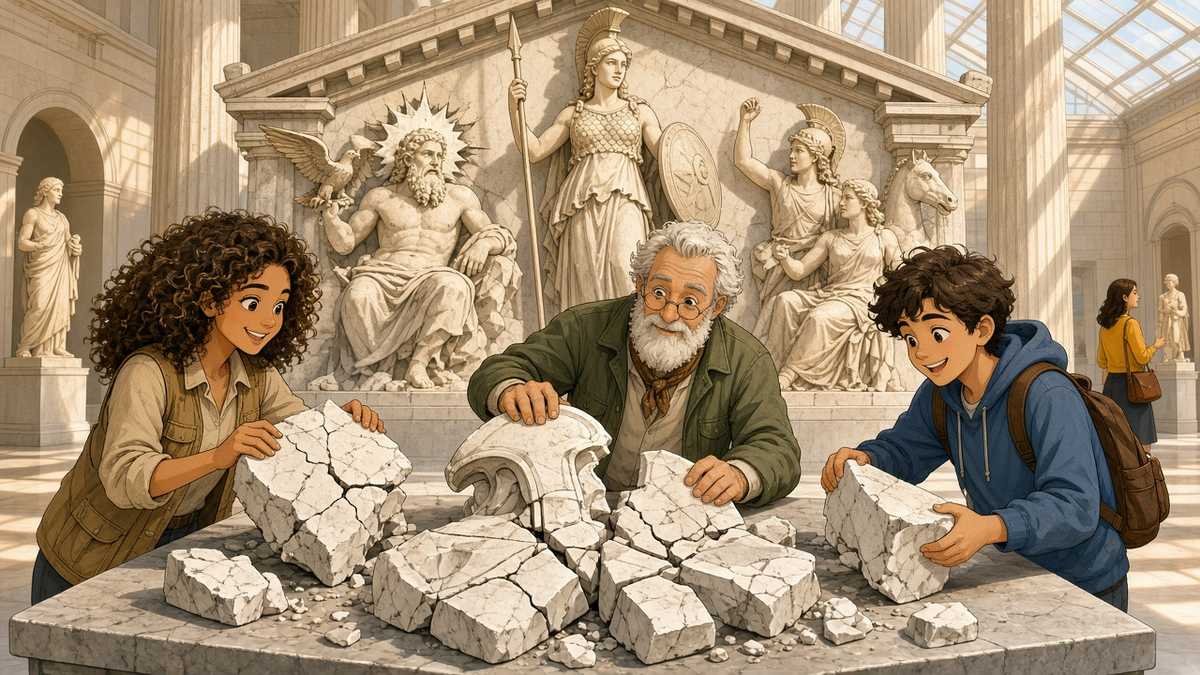
For more than two centuries, scholars have argued about one of the most famous gaps in art history: what exactly did the sculptures above the entrance of the Parthenon look like? The Liebieghaus Skulpturensammlung in Frankfurt am Main now offers an answer. Its exhibition “Bühne frei für Athena: Das Parthenon-Puzzle” (“Make way for Athena: The Parthenon Puzzle”), on view since 18 November 2026 and until 25 July 2027, presents what the museum calls the first archaeologically grounded proposal for a complete reconstruction of the temple’s east pediment.
A scene that was smashed to pieces
The east pediment, around 30 metres wide, showed the birth of the goddess Athena from the head of her father Zeus, surrounded by the Olympian gods. It originally held 39 monumental marble figures, created under the direction of the sculptor Phidias. Fires, earthquakes and human intervention destroyed most of it. Only eleven smaller sculptures from the corners survive in part; of the colossal central figures, roughly 240 fragments remain, scattered across several museums, many of them in Athens and a significant number in the British Museum.
Forty years of detective work
The team behind the reconstruction is led by Vinzenz Brinkmann, head of the Liebieghaus antiquities collection, who has worked on the problem together with archaeologist Ulrike Koch-Brinkmann for decades. The researchers re-examined around 60 surviving fragments with 3D scans – according to Brinkmann, an iPhone was enough to capture them on site – and matched them with ancient written sources.
The breakthrough came from Roman art. During a visit to the Hermitage in St Petersburg in 2014, Brinkmann saw a Roman sarcophagus relief depicting the birth of Athena and recognised figures from the pediment. Several such sarcophagi, most of them in Rome, show different sections of the composition. Beyond that, the Romans copied individual figures of the pediment again and again. The team became convinced that well-known statues – among them the Dioscuri on the Piazza del Quirinale in Rome and a figure of Hermes – go back to the Parthenon. “We suddenly found ourselves surrounded by old acquaintances,” Brinkmann told Deutsche Welle.
Three stages, a model and an animation
The exhibition walks visitors through the process in three reconstruction stages: what survives, the newly established attributions, and the resulting proposal for the full composition. A 3D-printed model at a scale of 1:7.7, about four metres long, shows the whole pediment, while life-size prints of key fragments are mounted on panels that outline the complete figures. The highlight is an animation in which the scattered pieces come together into one monumental scene. Works from the Liebieghaus collection are joined by loans from institutions including the Louvre and the Vatican Museums.
A puzzle with a political dimension
The show also touches on a sensitive issue. Loans from the Acropolis Museum in Athens did not materialise, which Deutsche Welle links to plans to show fragments from the British Museum as well – a reminder of the long dispute between Greece and the United Kingdom over the Parthenon sculptures in London. The exhibition closes with a look at the political conditions under which the Parthenon was built in the 5th century BC.
Whether every scholar will accept the Frankfurt proposal remains to be seen. But for visitors, the exhibition offers something rare: the chance to see a 2,500-year-old masterpiece, known for centuries only in pieces, as a coherent picture again.
Liebieghaus Skulpturensammlung, Schaumainkai 71, Frankfurt am Main. Admission during the exhibition: €12, reduced €10.