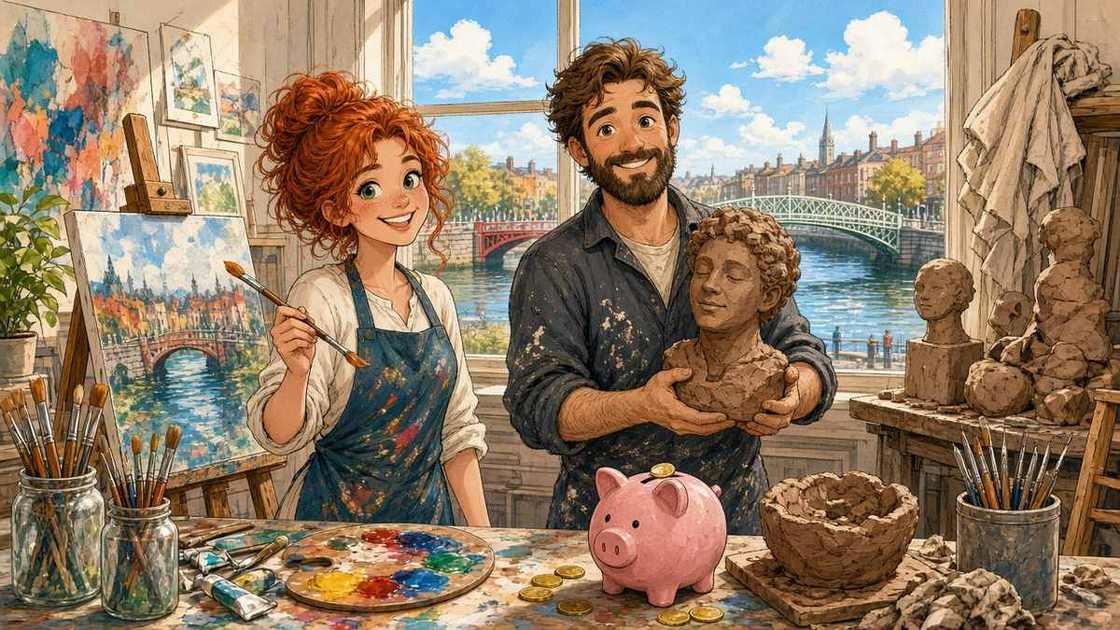
What happens when a state simply gives artists a steady income? Ireland has been running that experiment since 2022, and the latest reports from Dublin suggest a clear answer for the people involved: they make more art and worry less. Whether the scheme changes the wider art scene is a different question.
€325 a week, no strings attached
Under the Basic Income for the Arts (BIA) pilot, 2,000 Irish artists received €325 every week for three years, from 2022 to 2025. The aim was to provide a dependable base, reduce the need for unrelated side jobs and free up time for creative work. In February 2026 the government made the scheme permanent. Culture minister Patrick O’Donovan called it “a game changer” that is “here to stay”.
Speaking to ARTnews during Dublin Gallery Weekend this month, former recipients described the effect in personal terms. Dublin artist Gearóid O’Dea said his practice flourished; the money let him curate a Samuel Beckett–themed exhibition that travelled to Berlin and work with a collective of fellow artists. Cork-born Elinor O’Donovan was able to give up a part-time receptionist job and work as an artist full-time. Knowing the payment would arrive for three years, she said, improved her psychological wellbeing. Earlier evaluations of the pilot pointed in the same direction, with recipients reporting more hours spent on their art and greater financial security.
Ten thousand applicants, two thousand places
The criticism is not about the money itself but about its reach. Applications for the new three-year round opened in May, and around 10,000 artists applied – yet the number of places stays at 2,000, backed by a government commitment of €18 million. Eligible applicants are chosen by lottery, with demographic representation taken into account, and recipients can receive support for only three years in every six-year cycle.
Visual artist Tadhg Ó Cuirrín, himself a pilot recipient and active in the artists’ union Praxis, argues that this design undermines the idea. The scheme, he said, feels “less like a base income per se and more like a kind of a multi-annual grant chosen by lottery”. The three-years-on, three-years-off rhythm risks cutting income just as careers begin to take off. O’Dea, who has reapplied and is still waiting for a decision, says the prospect of losing the payment has brought financial anxiety back into his life.
Individual relief, limited wider impact
Interestingly, dealers, curators and museum directors in Dublin told ARTnews they had not noticed a broader effect on the city’s galleries or market. The scene itself is busy: Dublin Gallery Weekend, now in its fourth year, this time launched the first Francis Bacon Awards for Irish Visual Arts, with painter Patrick Graham and artist Cathy Wilkes among the winners. But the basic income works at the level of individual studios rather than sales figures.
That may be exactly the point. Ireland’s scheme is closely watched across Europe as a model for supporting artists without tying money to specific projects. Its next test is political: whether the government is willing to widen a programme that clearly works for those who win a place.