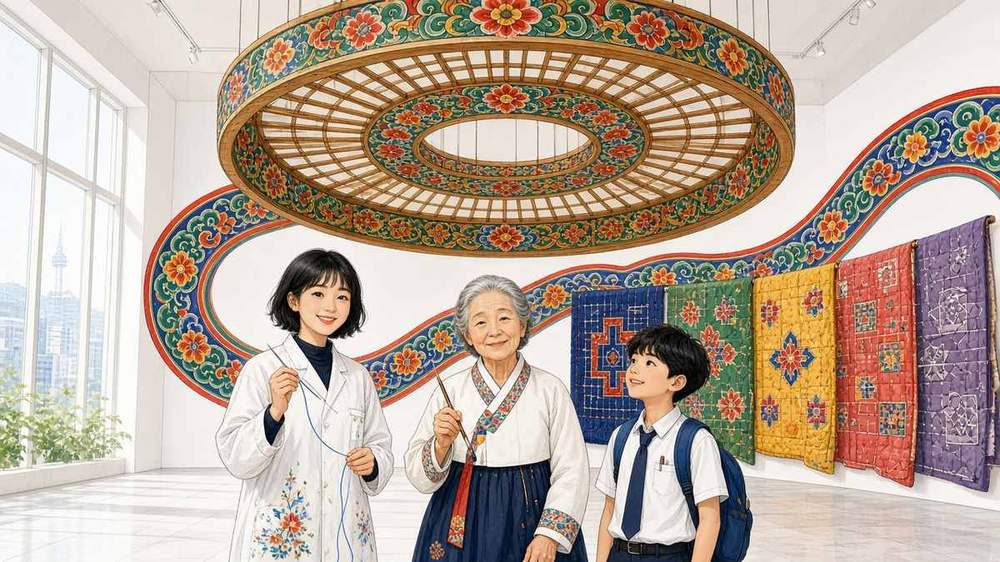
It has been a long time coming. Lee Seul-gi, the Paris-based Korean artist who won the Korea Artist Prize in 2020, is only now getting her first solo exhibition at a public art museum in her home country. Yomo Jomo Lee Seul-gi opens on 26 November 2026 at the Seoul Museum of Art (SeMA), at its main Seosomun branch in central Seoul, and runs until 28 February 2027. Admission is free.
The show gathers more than 70 works from the late 1990s to today, including nine new pieces commissioned by SeMA. Its title borrows a Korean word, yomojomo, for the many sides and shapes of a thing. Lee once described her method in those terms: turn a question over, look and listen from every angle, and the answer is already there.
Old technologies, new meanings
SeMA has made “technology” its theme for 2026, but the technologies on view here are ancient: the quilting needle and the brush used for dancheong, the traditional painting of colourful patterns on wooden architecture. For years Lee has collaborated with quilters in Tongyeong, with latticework and dancheong artisans across Korea, and with a women’s basket-weaving collective in Oaxaca, Mexico. Curator Lee Seung-ah stresses that the artist does not simply borrow these techniques but grows her own practice out of the knowledge stored in them.
Her best-known series, Blanket Project: U (since 2014), made with Tongyeong nubi quilting master Cho Sung-youn, turns Korean proverbs into the direction of quilted lines. In one, horizontal rows of stitching become a rat lying flat on the ground – the image behind a saying about keeping perfectly still. The project began, Lee recalled, when she went looking for traditional five-colour nubi quilts as gifts for French friends and was told nobody made them anymore.
Water made of wood
Suspended above the centre of the gallery hangs Slow Water (2021), a circular grid 11 metres wide, built from the lattice of traditional doors and painted in dancheong. What once divided inside from outside now floats horizontally in the air; as visitors move beneath it, the rigid wooden grid seems to ripple like water. On an adjacent wall, successors of dancheong master Yang Yong-ho have painted Flying Button, a work that will be painted over when the show closes.
The most physical new piece is Lelele, a single thick looping line that wraps around some 157 metres of wall. Lee compares it to the coiled cord of an old telephone, or to the loops children draw when practising handwriting – that uncertain stage before marks turn into letters. It was painted directly on the wall rather than enlarged from a sketch.
A show without sections
There are no chapters or thematic rooms: three decades of work share one open space so that pieces from different times and places can talk to each other. At the press preview Lee said she wanted to shed new light on the most basic human movements – opening one’s eyes, looking, getting up, picking things up, carrying, sleeping – at a time when much of life has become digital and relationships feel somewhat illusory. She also voiced scepticism about AI, calling it a drain on natural resources. As for meaning, she leaves that to the public: people can interpret the works however they like.