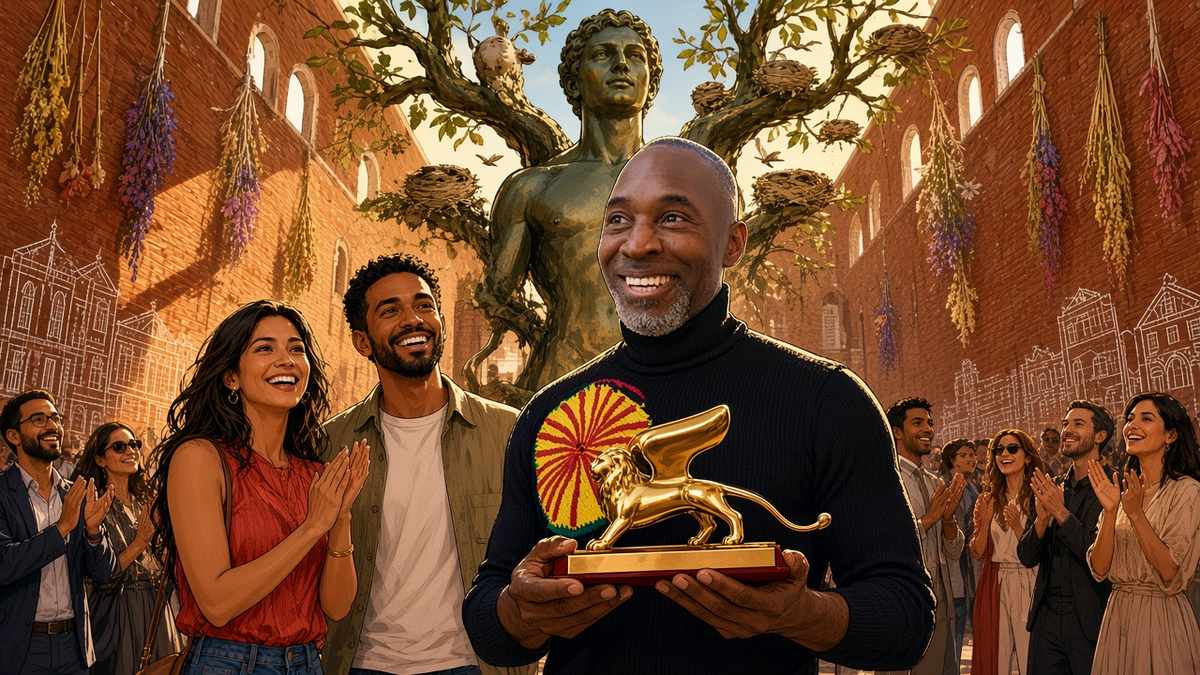
For the first time in its long history, the Venice Biennale has let its audience pick the winners. On 25 November 2026, three days after the 61st International Art Exhibition closed, La Biennale di Venezia announced its Visitors’ Lions: the award for Best Participant goes to the Chicago-based artist Nick Cave, and the award for Best National Participation goes to the Pavilion of India.
Why there was no jury
The Visitors’ Lions replaced the traditional Golden and Silver Lions after an unusual crisis. In April, the five-member international jury said it would not give prizes to pavilions or artists from countries whose leaders had been charged by the International Criminal Court – a stance aimed at Russia and Israel, whose leaders Vladimir Putin and Benjamin Netanyahu face ICC arrest warrants. Days later the jurors resigned. Many artists then withdrew from the competition in solidarity, among them participants of the main exhibition such as Alfredo Jaar, Zoe Leonard, Laurie Anderson and Otobong Nkanga, as well as artists representing 39 countries, including France, Austria, the Netherlands, Britain and Ukraine. Their names stayed on the ballot, but the Biennale made clear that votes for withdrawn entries would not be counted.
Voting was open to ticket holders who visited both main venues, the Giardini and the Arsenale, during the exhibition’s run from 9 May to 22 November. The Biennale has not published vote totals or rankings, saying its regulations do not provide for this – just as it never published the deliberations of its juries. So it remains unclear how the winners compared with entries that had withdrawn.
Nick Cave: seven stages of grief in bronze
Nick Cave, born in Chicago in 1959, is best known for his Soundsuits – wearable sculptures that sit between fashion, sculpture and performance. In Venice he showed a suite of seven works in the Arsenale, with one piece also installed outdoors, each addressing a stage of grief. Among them is Amalgam (Origin) (2024), a monumental bronze figure with branches sprouting from its body and birds nesting in the twigs.
His work was part of In Minor Keys, the main exhibition conceived by the late curator Koyo Kouoh. In a statement, Cave spoke of his gratitude for his friendship with Kouoh and for her decision to include him. The project, he said, acknowledges the history of violence and oppression endured by Black people in the United States while paying tribute to the beauty that community has created – and to the possibility of growing towards a different future.
India’s return after seven years
The winning national pavilion, Geographies of Distance: Remembering Home, marked India’s first participation in Venice in seven years. Commissioned by the National Gallery of Modern Art under India’s Ministry of Culture and curated by Amin Jaffer, it brought together five artists: Alwar Balasubramaniam, Sumakshi Singh, Ranjani Shettar, Asim Waqif and Skarma Sonam Tashi. Installed in the Arsenale, the show reflected on the rapid growth of Indian cities and the idea of home, with clay sculptures, dried flowers and plants hanging from the ceiling, and a demolished family house reconstructed in white thread.
A one-off with lasting questions
The people’s-choice format was introduced as a stopgap, and critics have called it divisive. Still, it produced two winners whose work speaks directly to loss, memory and belonging – themes that ran through Kouoh’s exhibition. Whether Venice returns to a jury in 2028, or keeps some role for its visitors, is now one of the more interesting open questions in the art world.