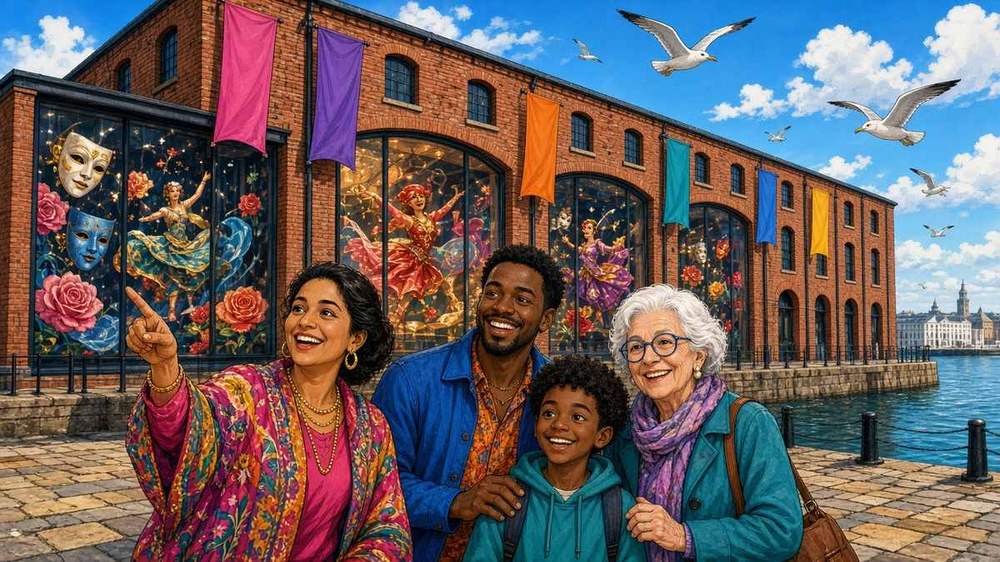
Liverpool’s outpost of the Tate finally has a reopening date in sight. Tate Liverpool, which closed in October 2023 and was originally due back in 2025, will reopen in autumn 2027 after a four-year redevelopment costing around £30 million, as reported by The Art Newspaper on 25 November 2026. The gallery sits on the Royal Albert Dock and is one of four Tate sites, alongside Tate Modern, Tate Britain and Tate St Ives.
Surrealism goes on stage
The headline exhibition of the relaunch is Surrealism: Staging Dream Worlds, running until spring 2028. Instead of another survey of melting clocks, it looks at Surrealism’s close ties to theatre and dance – from masquerade, role play and invented characters to major commissions for stage sets and costumes. Works by Salvador Dalí, Eileen Agar and Man Ray are among those announced. One highlight is Claude Cahun’s photograph of Sheila Legge’s 1936 performance Surrealist Phantom of Sex Appeal, for which Legge appeared in London’s Trafalgar Square in a Dalí-inspired costume, her head hidden behind a mass of roses.
A homecoming retrospective
Alongside it, Tate Liverpool will stage the first major retrospective of Chila Kumari Singh Burman, the Liverpool-based artist known for exuberant, politically sharp work mixing neon, printmaking, collage and South Asian popular imagery. Many visitors will remember her 2020 Winter Commission, when she covered the façade of Tate Britain in London with glowing neon figures and symbols. A retrospective in her home city gives the reopening a strong local accent.
The first major commission for the gallery’s Art Hall goes to Asad Raza, an artist based in New York and Berlin whose installations often involve living systems, soil, plants and social interaction.
New spaces by 6a architects
The redesign is by the London practice 6a architects. According to Tate, the new galleries will open up space to show the variety of the national collection and host large exhibitions, alongside new public areas for play, rest and learning with views across the River Mersey. The aim is to tie the building more closely to the city and its communities.
Funding came largely from the public purse: £18.6 million from the Public Bodies Infrastructure Fund, awarded via the UK Department for Digital, Culture, Media and Sport. Philanthropic support includes £3 million from the Garfield Weston Foundation, £1.25 million from the Wolfson Foundation and a gift from the Ross Warburton Charitable Trust, along with other trusts and individuals.
A James Stirling landmark
Tate Liverpool opened in 1988 in a converted dock warehouse. Architect James Stirling turned the north-west corner of the seven-storey brick building into a five-storey gallery. Visitor numbers show why the reopening matters: about 660,000 people came in 2019, before the pandemic, and 405,000 in 2022, its last full year of operation.
The leadership is also in transition. Helen Legg stepped down as director earlier this year; Jemima Pyne is leading the gallery on an interim basis. A permanent director will be recruited once the new head of Tate, Jessica Morgan, takes up her post next year.