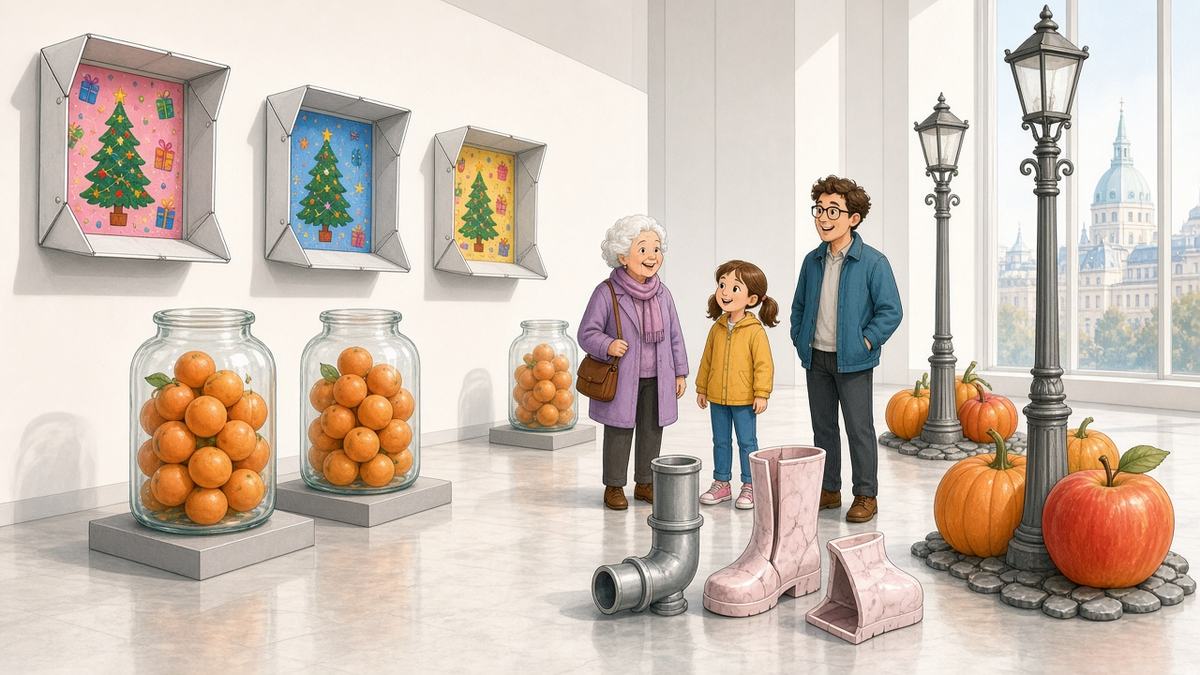
Drainpipes, detergent boxes, street lamps and pizza cartons: the everyday clutter of city life is the raw material of Magali Reus. From today, 27 November 2026, Kunsthalle Wien in the MuseumsQuartier presents Tenant, the first solo exhibition in Austria by the Dutch artist, who was born in The Hague in 1981 and works in London. The show runs until 2 May 2027 and will then travel to Winterthur in Switzerland and Bordeaux in France.
Curated by Kunsthalle director Michelle Cotton, it is one of the largest presentations of Reus’s work to date. Around 80 sculptures made between 2014 and 2026 are on view, about 15 of them new. Some were made specifically with Vienna in mind.
Familiar things, slightly off
Reus does not simply display found objects. She rebuilds them, shifts their scale, swaps their materials and inner workings and combines them with other motifs until the original item has slipped out of its everyday role. The recent series Subs shows how this works: opened pizza boxes, recreated one to one in aluminium, each holding a photograph of a discarded Christmas tree against a screen-printed gift-wrap pattern. At a press preview, the artist explained that January feels like a sad month to her, with recently decorated trees suddenly lying in the streets; she began photographing them in different cities. Pizza boxes, wrapping paper and trees, she noted, all come from the same raw material: wood.
A wink at Vienna
The three-part series Tenant, which gives the exhibition its name, refers to the three venues of the tour. At its centre are sculptures in the shape of drainpipes, the kind of plumbing found in houses and urban infrastructure, combined with rubber boots carved from marble and split lengthwise. In the Vienna version the halves are a delicate pink and carry the words “Good Manners” and “Bad Manners” – lettered in the style of a famous Viennese wafer brand, a humorous nod to the host city. Further references to Vienna, from architectural quotations to hints at the city’s musical tradition, are woven into the exhibition design.
Elsewhere, six of the historicising street lamps from the series Candlesticks (2022) are spread through the hall. They cite different kinds of lighting from sodium to LED, track the hours of sunlight that crops need, and hold oversized fruit and vegetables at their base.
Home, care and memory
Domesticity runs through many of the works. Oversized jam jars in Clementine (2023–26) recall her grandmother’s preserving. The seven-part Foundations (2024) uses linen cloths bought from rural French bakeries, on which rising baguette dough has left its traces; the fabric is embroidered with the grains needed for baking and framed by vitrines shaped like dormer windows. The new series Of Rain embeds textiles modelled on her mother’s and grandmother’s towels in giant packaging that looks like cut-open detergent boxes – the printed care symbols suddenly read as signs of care in a second sense.
The exhibition opened on Thursday evening with a conversation between Reus and frieze editor-in-chief Andrew Durbin. It is accompanied by a new German-English publication with essays by Michelle Cotton, Brian Dillon and Vanessa Peterson and an extended interview with the artist by Lynn Kost.