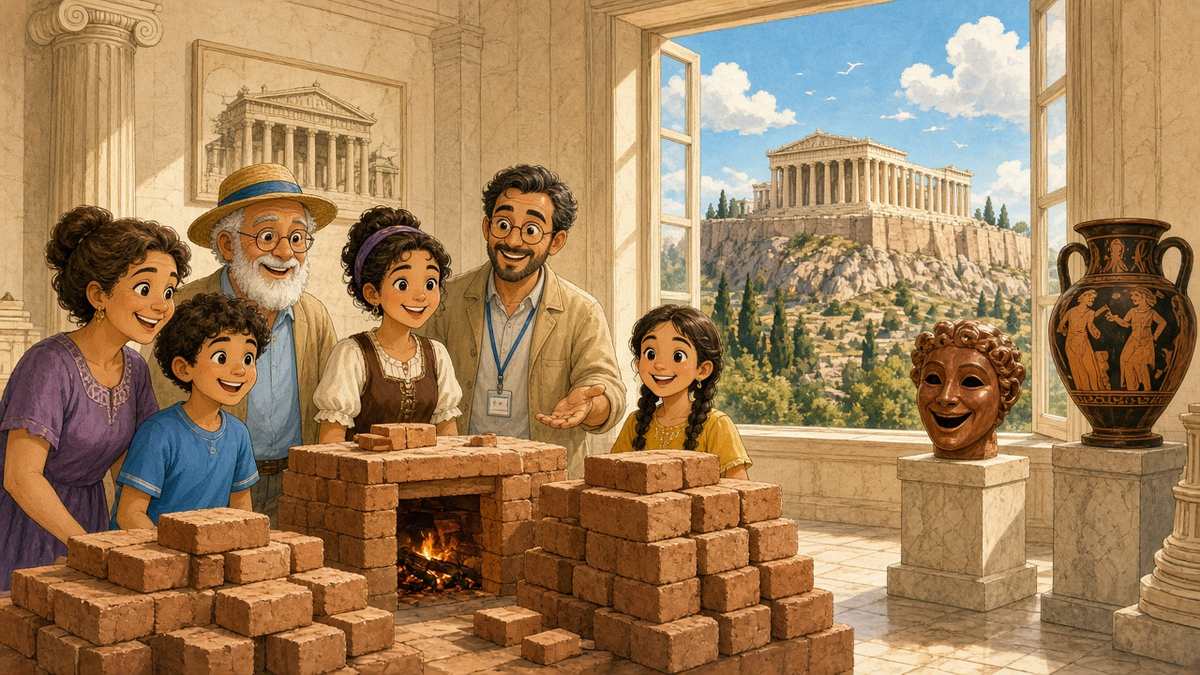
For almost twenty years it stood silent on the rock of the Acropolis. Now the Old Acropolis Museum in Athens is open again. The building, founded in 1874 and regarded as the first museum built in modern Greece, reopened on Monday, 23 November 2026, after an extensive restoration. It is the first time since 2007 that the public can walk through its rooms.
From storage plan to living museum
The museum lost its central role in 2009, when the new Acropolis Museum opened a short walk down the hill. The larger, modern building took over the antiquities from the Parthenon and other sites, including a gallery designed for the Parthenon sculptures that is currently filled with casts – in the hope that the originals held in London might one day return. The old house on the hill was left empty, and for a while there were plans to turn it into storage and offices.
By 2019 the Greek state had abandoned that idea. At the opening ceremony, attended by Prime Minister Kyriakos Mitsotakis, Culture Minister Lina Mendoni said, according to The Art Newspaper, that converting such a historic building in such a location into offices had seemed inconceivable to her ministry. Instead, the museum is meant to return to its original purpose – but not as a conventional collection display. It will host exhibitions on the history, archaeology and culture of Athens alongside contemporary art inspired by Greek civilisation and programmes using new technology.
“Athens City Idea”
The first exhibition, Athens City Idea, approaches Athens as a social, political and economic organism. Tragic masks, statues, coins and amphorae that had been kept in stores around the city are shown together with recent archaeological finds. A digital component brings movement to the Parthenon friezes and tells the long story of the Acropolis hill. The plan to change the displays regularly is intended to keep the house current rather than freezing it as another permanent gallery.
A kiln and bricks on the sacred rock
The contemporary side is represented by the American artist Michael Rakowitz. His installation What You Leave Behind Is Not What Is Engraved (2026), made up of a kiln and freshly fired bricks, is the final part of a trilogy of works he created for Athens. It is also the last project of Neon, the nomadic foundation set up by collector Dimitris Daskalopoulos, which has funded art and exhibitions across the city for fourteen years and announced its closure earlier this year. Daskalopoulos also supported the refurbishment of the museum, which was paid for with both public and private money.
Rakowitz looks at a chapter of the Acropolis story that is rarely told: the population exchanges at the end of the Ottoman Empire, when Greece and Turkey forced around 1.5 million people to leave their homes. Refugees arriving in Athens set up tents and camps at the foot of the Acropolis hill. The artist learned that people who were later able to visit their lost homelands often found their houses in ruins and took a single brick back with them as a keepsake.
His installation combines such original bricks with new ones bearing stamps and inscriptions about more recent displacement. He developed them with survivors of the 1920s population transfers and with women from the Melissa Network, a non-profit that supports migrant women in Greece. Rakowitz told The Art Newspaper that he wants the bricks to become the foundation of a city that welcomes strangers instead of pushing them back to sea.
Why it matters
The reopening gives Athens a second museum on the Acropolis with a very different mission from its larger neighbour: less a treasury of masterpieces, more a stage where the city reflects on itself. That its first contemporary voice speaks about refugees who once camped below the Parthenon makes clear that this ancient site is also part of a modern, unfinished history.