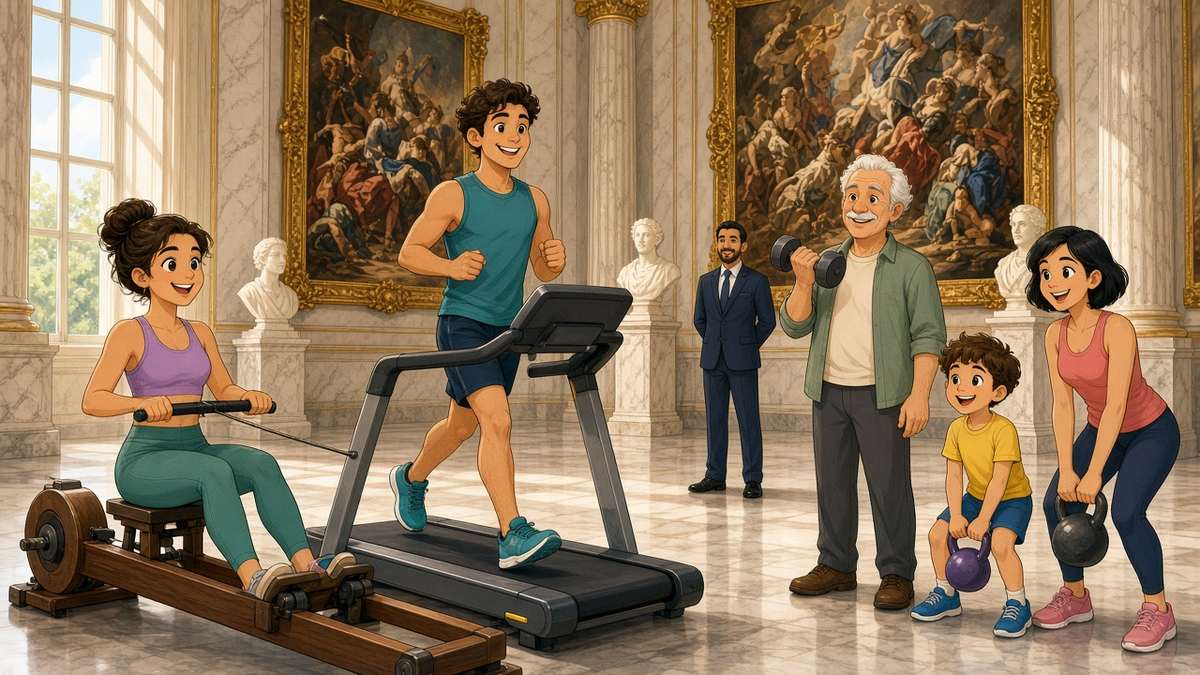
Treadmills beside Baroque busts, kettlebells near Old Masters: the Kunstpalast in Düsseldorf has turned its permanent collection into what it calls a fully functioning gym – according to the museum, a first for an art museum anywhere in the world. The intervention, titled “GYM. Fit with Art”, opened on 5 November and runs until 21 February 2027. This week it drew fresh international attention through reports by CNN, ARTnews and the Times of London.
A centenary with dumbbells
The idea has a local history. In 1926, Düsseldorf’s Ehrenhof hosted the GeSoLei, the Great Exhibition for Health Care, Social Welfare and Physical Exercise. With around 7.5 million visitors, it attracted more people than any other exhibition of the Weimar Republic, and the monumental Ehrenhof ensemble designed by architect Wilhelm Kreis – today’s Tonhalle, the Rheinterrasse and the museum buildings – was erected for it in just 18 months. A hundred years later, the Kunstpalast marks the anniversary with a parallel “Spot On” presentation on the GeSoLei and with sport in the galleries.
Among paintings, sculptures and design objects, the museum has placed more than 70 pieces of exercise equipment and 23 exercise stations, grouped into around 20 stations for cardio and strength training. The collection of over 800 works ranges from Peter Paul Rubens to Gerhard Richter. The project is sponsored by TARGOBANK and realised in cooperation with the fitness equipment maker Technogym. Visitors check in with a regular museum ticket (17 euros, 13 euros reduced, free for under-18s) or, as in a normal gym, with an Urban Sports Club membership. Drinks in resealable bottles are explicitly allowed.
Classes, AfterWorkOut and a few raised eyebrows
The programme includes classes such as yoga, Pilates, barre, Muay Thai, dance and HIIT, which require booking; on Thursday evenings an “AfterWorkOut” offers free training with music from 6 to 9 pm. According to Alina Fuchte, deputy head of education, who leads the project, the classes were fully booked before the opening. Trainers are present at weekends, and each station explains its use via instructions, video and an app; the museum took legal advice before launching.
The aim is to reach people who would rather spend a weekend at the gym than in a museum, including younger audiences. Fuchte told CNN that some participants had never visited the Kunstpalast before and came after seeing an advert in their gym. General director Felix Krämer describes the project as bringing together two worlds that at first glance have little in common, asking what happens when the usual idea of a museum visit is challenged.
Not everyone is convinced. Fuchte acknowledges that some visitors are irritated and feel the equipment does not belong in a museum; one visitor quoted by the Times found it strange to see children lifting barbells in front of old Italian paintings. The museum stresses that nobody has to work out – those who prefer to look at the art in peace are just as welcome – and that the intervention is temporary.
It continues a series of experiments in which the Kunstpalast has previously brought flowers and scents into its collection. Whether museum fitness becomes a model elsewhere remains to be seen; in Düsseldorf, at least, the galleries are currently full of people in sportswear.