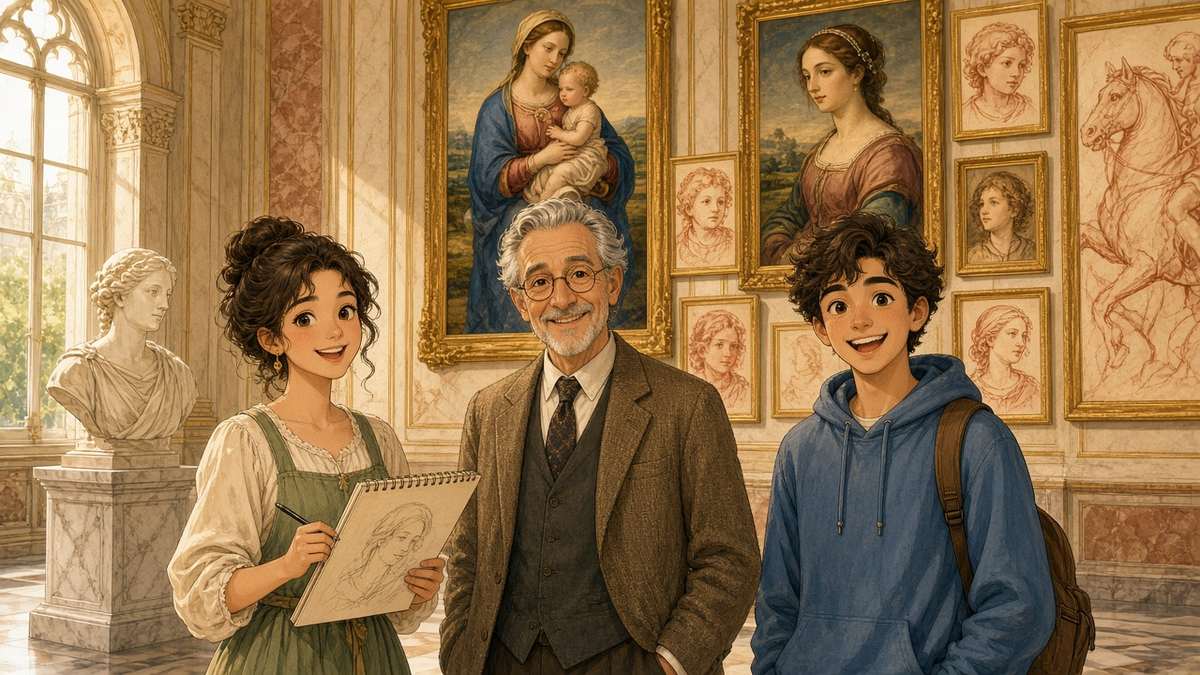
Leonardo da Vinci spent many of his most productive years in Milan – and left behind far more than the Last Supper. A new exhibition at the Gallerie d’Italia on Piazza della Scala now looks at what his presence did to the art of Lombardy. “Nel segno di Leonardo. Allievi e seguaci a Milano” (In the Footsteps of Leonardo: Pupils and Followers in Milan) opened to the public on 27 November 2026 and runs until 4 April 2027.
Not one style, but many
Organised by Intesa Sanpaolo and curated by Simone Facchinetti and Arturo Galansino, the show brings together around 120 paintings, drawings, prints and sculptures. Rather than placing Leonardo alone at the centre, it follows the artists who worked alongside him, trained in his workshop or later developed his ideas, reconstructing almost a century of art history. The organisers present it as the first comprehensive account of the Leonardesque school in Lombardy, arguing that his pupils did not simply copy the master but transformed his lessons into distinctive languages of their own.
The story begins with Leonardo’s long stay at the court of Ludovico Sforza, known as il Moro: he arrived in Milan in 1482, remained until 1499 and returned in 1506. Eight thematic sections lead from Lombard masters active before his arrival – among them Vincenzo Foppa, Bergognone, Bernardino Zenale and Bramantino – to his first workshop pupils, such as Marco d’Oggiono and Giovanni Antonio Boltraffio, and close collaborators like Giovanni Antonio de Predis and Francesco Napoletano. Later chapters feature Andrea Solario, Bernardino Luini, Cesare da Sesto, Giovanni Agostino da Lodi, Giampietrino, Salaì and Francesco Melzi, the pupil who became custodian of Leonardo’s drawings and writings. The Master of the Sforza Altarpiece, recently identified as Giovanni Angelo Mirofoli, is also represented.
Leonardo himself, and the art of drawing
Two works by Leonardo anchor the display: the Saint Jerome from the Vatican Museums and the Head of a Young Woman, known as La Scapigliata, from the Galleria Nazionale di Parma. A dedicated section is devoted to drawing, the field in which Leonardo introduced innovative techniques that shaped Renaissance Lombardy. By comparing drawings, paintings and sculptures, the exhibition shows how his investigations into nature, light and human emotion were reinterpreted by others. Sculpture gets its own focus, especially Agostino Busti, known as Bambaia, presented as one of the most important interpreters of Leonardo’s legacy, with work by Cristoforo Solari as well.
Loans from major collections
The list of lenders reads like a who’s who of European and American museums: the Vatican Museums, the Pinacoteca di Brera, the Veneranda Biblioteca Ambrosiana, the Castello Sforzesco museums, the Uffizi, the Galleria Borghese, Capodimonte, the National Gallery in London, the Louvre, the British Museum, the Kunsthistorisches Museum in Vienna and the National Gallery of Art in Washington, among others. The exhibition is held under the High Patronage of the President of the Italian Republic, in collaboration with the Castello Sforzesco museums, and is accompanied by a scholarly catalogue published by Allemandi.
For visitors to Milan this winter, the show offers a chance to see Leonardo not as an isolated genius but as the starting point of a whole constellation of artists who defined the visual identity of the duchy – and whose names deserve to be better known.