What would cities, products and buildings look like if we designed them not only for people but also for animals, plants and whole ecosystems? That question drives More than Human: Making With the Living World, which opened at ArtScience Museum in Singapore on 28 November 2026. It is the Asian debut of a touring exhibition from the Design Museum in London, and it runs until 16 May 2027.
A bigger, Asian edition
The London original was developed with Future Observatory, the Design Museum’s national research programme for the green transition, with support from the UK Arts and Humanities Research Council. For Singapore, ArtScience Museum co-curated the show with the Design Museum and added 25 new works drawing on the landscapes, species and cultural traditions of Singapore and the wider region, with support from DesignSingapore Council. In total the exhibition presents more than 140 artworks, objects, installations and hands-on experiences by close to 55 artists, designers, architects, researchers and communities.
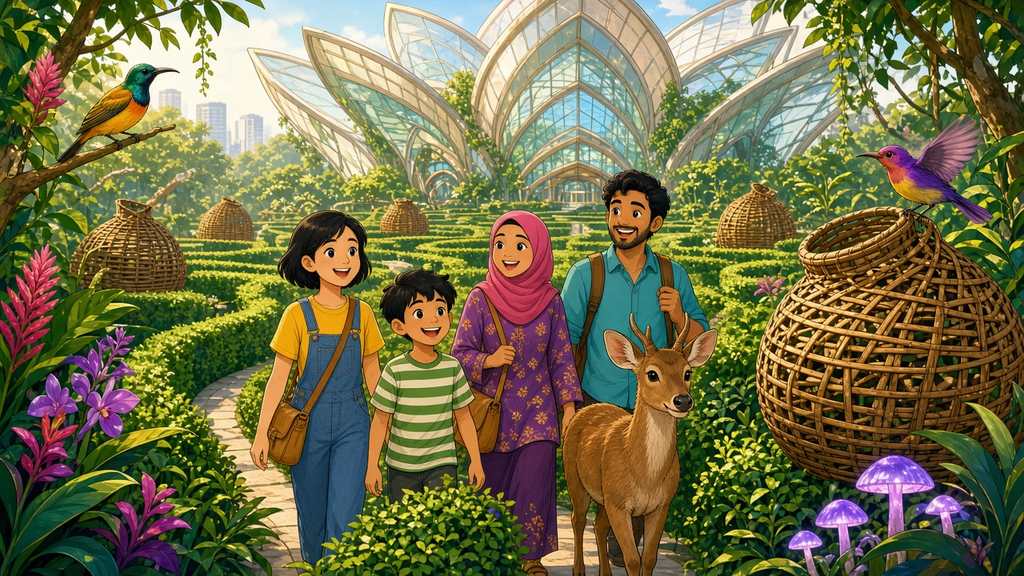
The exhibition architecture, by Singapore-based Lekker Architects, takes its cues from hedge mazes, archipelagos and woodland, guiding visitors through three chapters.
Being Landscape
The first chapter looks at Indigenous knowledge and older relationships between people and nature. Zarina Muhammad draws on Southeast Asian maritime histories in Observing Omens Drawn by Lightning (2025). Zheng Bo‘s Ecosensibility Exercise: Fragrant Eight-Section Brocade (2024) reinterprets the Chinese practice of qigong as an exchange between body and plants. In Within the Forest (2026), Cambodian artist Khvay Samnang explores the knowledge and spiritual traditions of the Indigenous Chong people with videos and animal masks made together with Chong craftspeople.
Making with the World
The second chapter treats other species as collaborators in design. Superlative Futures imagines architecture from the point of view of seeds in Seed Palaces (2026). Studio SKLIM‘s Lo-Hi Tech 03: Urban Bio-Tats (2026) uses plant-based biocomposites, terracotta, solar technology and biotextiles to build modular homes for city wildlife such as the common palm civet, the red junglefowl and the ornate sunbird. For Alam Se-Kita Reimagined (2026), a commission by the museum, the studios thesupersystem and VAAS worked with field research on Singapore’s sambar deer to develop what they call poly-species design – the Malay title means roughly “our place as one”. Historic fish and crustacean traps from the Malay Peninsula and Borneo, lent by the Asian Civilisations Museum, show that design shaped by the rhythms of other species is nothing new.
Shifting Perspective
The final chapter asks visitors to look at the world from beyond a purely human point of view. The museum frames the show for all ages, with guided tours and a children’s tour in which young visitors move through the galleries “as a bee”. The opening evening, titled In Relation, brought artists and designers into the galleries for roving conversations.
Why it matters
“More-than-human design” has become a lively field in architecture and product design, but it often stays theoretical. In Singapore, a dense city that is also home to returning species such as the sambar deer, the exhibition makes the idea concrete. Its strength lies in mixing speculative prototypes with craft traditions and Indigenous knowledge – a reminder that designing with nature is as much about listening as inventing.